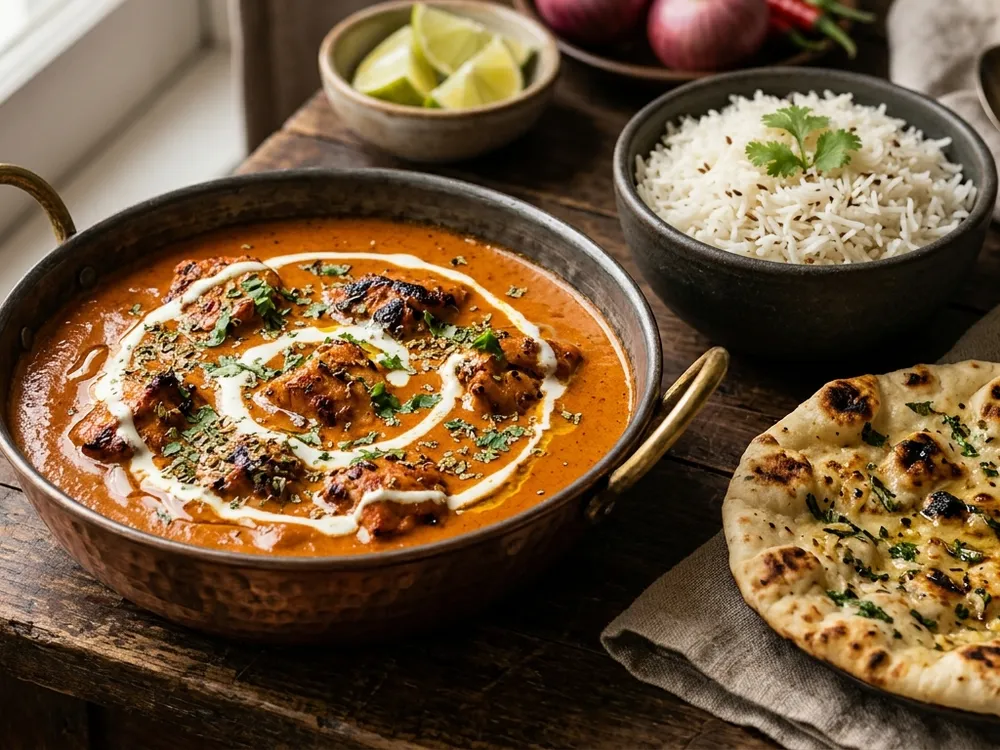
Pick up a Butter Chicken meal kit or jar of simmer sauce at a Dutch supermarket and you will usually end up with pale cubes of chicken breast poached in a sweet, heavy tomato-cream soup. It gets dinner on the table in twenty minutes, but it misses the two foundational contrasts that define North Indian Murgh Makhani: smoky, charred edges of yogurt-marinated dark thigh meat against a satin-smooth makhani gravy perfumed with green cardamom, cultured butter, and crushed dried fenugreek leaves (kasoori methi).
The dish originated in the 1950s at the Moti Mahal restaurant in the Daryaganj neighborhood of Old Delhi, where chefs Kundan Lal Gujral and Kundan Lal Jaggi needed a way to keep unsold portions of tandoori chicken from drying out. Their solution was to fold the charred chicken into a rich emulsion of simmered tomatoes, butter (makhan), cream, and aromatic spices. Because of that history, there is no single rigid “authentic” formula across India: traditional Old Delhi kitchens often make the gravy entirely without onions, whereas Mumbai restaurant kitchens frequently build extra body with sautéed onions and soaked cashew nuts.
When cooking in the Netherlands, the tomato-and-cashew method solves a major local ingredient problem: fresh Dutch supermarket tomatoes outside peak August summer are too watery and acidic for a true makhani base. By starting with bottled Italian passata, blending in 25 grams of soaked raw cashews, and blistering yogurt-marinated kippendijfilet in a cast-iron skillet or at 200°C in the air fryer, you can put a velvety, restaurant-caliber Butter Chicken on the table in 45 minutes without spice packets or artificial food dye.
Why Chicken Thighs and High Heat Are Non-Negotiable
The most common flaw in Western home recipes is simmering raw chicken breast directly in the tomato sauce. When lean breast meat poaches in liquid, its muscle fibers contract and expel watery proteins into the gravy, leaving the meat stringy and the sauce diluted.
In Murgh Makhani, the chicken should bring smoky Maillard complexity to the pot before it ever touches the sauce:
- Boneless chicken thighs (kippendijfilet): Contain enough intramuscular fat to withstand 200°C roasting without drying out.
- 10% fat Greek yogurt marinade: Forms a thick protective paste with ginger, garlic, lemon juice, garam masala, and Kashmiri chili. When this coating hits hot cast iron or the high-speed airflow of an air fryer, the milk sugars and proteins caramelize into dark, smoky blisters.
- Brief final simmer: The charred chicken is folded into the strained gravy only for the final 5 to 6 minutes—just long enough for the smoky meat juices to mingle with the butter emulsion and for the thickest pieces to reach a safe internal temperature of at least 75°C.
Dutch Supermarket vs. Toko Shopping Guide
Almost every ingredient for this recipe sits on the shelves of Albert Heijn, Jumbo, or Lidl. Only two specialty Indian aromatics—Kashmiri chili powder and kasoori methi (dried fenugreek leaves)—come from an Asian or Indian grocer such as Amazing Oriental (check our Toko Finder for locations across the Netherlands), and both have reliable supermarket approximations:
| Ingredient | Culinary Role in Butter Chicken | Where to Buy in the Netherlands | Practical Supermarket Approximation |
|---|---|---|---|
| Chicken thighs (kippendijfilet, 600 g) | Stays juicy under high heat and enriches the sauce with savory drippings | Any Dutch supermarket, poultry stall, or Turkish butcher | Bone-in drumsticks (see our Air Fryer Tandoori Chicken recipe) |
| Greek yogurt (10% fat) | Clings thickly to the chicken without weeping whey into the pan | Any supermarket dairy aisle (Griekse yoghurt 10% vet) | 175 ml regular full-fat yogurt (volle yoghurt), drained for 30 min in a paper-towel-lined sieve |
| Tomato passata (500 g bottle/carton) | Provides concentrated, sweet-tart ripe tomato flavor without tough skins | Any supermarket pasta aisle (e.g., Mutti or store brand) | 1 can whole peeled tomatoes (400 g) + 100 ml water, blended an extra 60 seconds |
| Raw unsalted cashews (25 g) | Emulsifies the blended tomato gravy into a glossy, non-splitting sauce | Any supermarket nut aisle or baking section | 25 g blanched almonds (soaked) or 1.5 tbsp smooth 100% cashew butter |
| Kashmiri chili powder (3 tsp) | Delivers vibrant brick-red color and fruity, gentle warmth | Indian/Asian toko (brands like TRS, MDH, or Heera) | 2.5 tsp sweet paprika (paprikapoeder edelsüss) + ½ tsp cayenne pepper |
| Kasoori methi (1 tbsp) | Dried fenugreek leaves; adds the signature smoky, maple-and-lovage restaurant finish | Toko, Indian grocers, and select large AH XL stores | 1 tsp dried celery leaves + tiny pinch ground fenugreek seed + ½ tsp pure maple syrup |
Two Ways to Char the Chicken: Cast-Iron Skillet vs. Air Fryer
Since few Dutch apartments come equipped with a 450°C clay tandoor, you can choose between two high-heat methods in Step 5 that both produce dark, blistered edges:
- Option A — Heavy Cast-Iron Skillet or Grill Pan (Classic Stovetop): Heat 1 tablespoon of neutral oil over medium-high to high heat until shimmering. Arrange the marinated thigh chunks in a single uncrowded layer and sear undisturbed for 3 to 4 minutes per side until the spiced yogurt crust chars dark golden brown.
- Option B — The Air Fryer Tandoori Shortcut (200°C, 10–12 minutes): Preheat your air fryer to 200°C. Arrange the marinated chicken pieces in a single layer on the lightly oiled grate and roast for 10 to 12 minutes (flipping halfway). The concentrated convection airflow blisters the yogurt crust while excess moisture drips away below—the exact technique behind our standalone Air Fryer Tandoori Chicken. Better yet, while the air fryer roasts the chicken hands-free, your stovetop stays completely clear to simmer the makhani gravy.
Step-by-Step Cooking Method
Start by placing the 25 g of raw unsalted cashews in a small bowl, covering them with boiling water, and letting them soak for 15 minutes while you prep the chicken.
Step 1: Pat the 600 g of boneless skinless chicken thighs dry with paper towels and cut them into generous 4 cm chunks. In a mixing bowl, whisk together the 100 g full-fat Greek yogurt (10% fat), 1 tbsp lemon juice, 1 tbsp finely grated fresh ginger, 3 finely grated garlic cloves, 1.5 tsp Kashmiri chili powder (or 1.25 tsp sweet paprika + ¼ tsp cayenne), 1 tsp garam masala, 1 tsp ground cumin, ½ tsp ground turmeric, and ¾ tsp fine sea salt. Toss the chicken pieces until thickly coated. Marinate for at least 15 to 20 minutes at room temperature (or cover and refrigerate for up to 12 hours).
Step 2: Heat 1 tablespoon of neutral oil and 20 g of unsalted butter in a heavy Dutch oven or deep skillet over medium heat. Add the 4 lightly bruised green cardamom pods, the 4 cm cinnamon stick, and the 3 whole cloves. Let the whole spices sizzle for 30 to 40 seconds until fragrant. Add the finely diced onion and sauté for 6 to 7 minutes until softened and lightly golden around the edges.
Step 3: Stir in the remaining 1 tbsp grated fresh ginger and 3 grated garlic cloves, cooking for 1 minute until the raw garlic aroma disappears. Add the 1.5 tbsp concentrated tomato paste, the remaining 1.5 tsp Kashmiri chili powder, and 1 tsp garam masala. Cook over medium heat for 2 minutes, stirring constantly; frying the tomato paste and chili powder in the butter removes any tinny sharpness and dissolves the red carotenoids into the fat.
Step 4: Pour in the 500 g tomato passata, 100 ml warm water, the drained soaked cashews, and ¾ tsp fine sea salt. Bring the mixture to a gentle bubble, lower the heat, set the lid slightly ajar, and simmer gently for 12 to 15 minutes until the tomatoes mellow, thicken, and show a faint sheen of orange butter fat around the edges.
Step 5: Meanwhile, char the marinated chicken thighs using Option A (skillet) or Option B (air fryer): for the skillet, heat 1 tbsp neutral oil over high heat and sear the chicken in a single layer for 3 to 4 minutes per side until darkly blistered; OR roast in a preheated air fryer at 200°C for 10 to 12 minutes (flipping halfway). The chicken only needs to be about 85% cooked through at this point, as it will finish cooking inside the hot gravy.
Step 6: Pluck out the cinnamon stick and whole cloves from the simmered tomato base (you can leave the green cardamom pods in if straining, or remove them now if skipping the sieve). Blend the tomato-cashew sauce with an immersion blender or countertop blender for 1 to 2 minutes until completely smooth, glossy, and velvety. For true restaurant satin texture: press the blended gravy through a fine-mesh strainer back into the clean pot using the back of a ladle to catch any lingering seed hulls or ginger fibers.
Step 7: Return the smooth makhani gravy to low heat and stir in the 1 tablespoon of honey (or sugar). Add the charred chicken thigh pieces along with every drop of resting juices from the plate or pan. Simmer gently over low heat for 5 to 6 minutes. Check the thickest piece of chicken with an instant-read thermometer: for poultry food safety, the internal temperature must reach at least 75°C (dark thigh meat is most tender between 80°C and 85°C).
Step 8: Turn the burner completely off (or to the lowest possible warm setting so the sauce stops bubbling). Add the 40 g of ice-cold cubed unsalted butter and the 100 ml of heavy whipping cream, stirring gently until the cold butter melts slowly into a glossy emulsion (monter au beurre). Finally, place the 1 tablespoon of dried kasoori methi between your dry palms, rub your hands briskly together directly over the pot so the fine aromatic leaves rain into the gravy, stir once more, and scatter with fresh cilantro.
The Kitchen Science Behind a Velvety Makhani Emulsion
Why does homemade Butter Chicken sometimes separate into a grainy tomato sauce with yellow pools of melted butter floating on top, whereas a great Indian restaurant’s gravy clings to a piece of naan like satin ribbon? Three small technical details govern the texture:
1. Soaked cashews as a natural emulsifier
Soaked raw cashews contain a dense matrix of starch granules, plant proteins, and microscopic oil droplets. When blended at high speed with simmered tomato passata, those cashew proteins form a stable emulsion that binds water and fat together. That gives the gravy rich body before any dairy cream is added—allowing you to use just 100 ml of heavy cream instead of drowning the spice profile in a full carton of cooking cream.
2. Mounting cold butter off the heat (monter au beurre)
Dairy butter is itself a water-in-fat emulsion containing roughly 16% water. If you boil butter aggressively inside an acidic tomato sauce, the water evaporates and the milk fat breaks out into greasy yellow slicks on the surface. By cutting 40 grams of butter into ice-cold cubes and swirling it in after turning off the burner, the butterfat stays suspended inside the cashew-stabilized tomato gravy, creating a mirror-like sheen.
3. Why you crush Kasoori Methi between your palms
Dried fenugreek leaves (kasoori methi) owe their unmistakable aroma to sotolon—the same aromatic lactone found in lovage, aged sake, and toasted maple syrup. Whole dried fenugreek also contains woody little stems that taste bitter if dumped straight from the box. Rubbing the dried leaves between your warm palms over the pot sifts only the brittle, fragrant leaf flakes into the sauce while leaving any tough stems behind in your hand, and the friction warms the essential oils right as they hit the steam.
Troubleshooting Common Pitfalls
| Issue in the Pot | Why It Happens | Immediate Fix |
|---|---|---|
| Sauce tastes sharp or overly acidic | The tomato paste wasn’t caramelized long enough in Step 3, or the passata brand was extra tart | Simmer uncovered for 5 extra minutes over low heat and stir in an extra ½ to 1 teaspoon of honey or sugar until rounded |
| Yellow butter fat separates on top | The sauce boiled hard after the final butter and heavy cream were added | Remove from the heat, add 1 tablespoon of cold heavy cream or hot water, and whisk vigorously (or pulse briefly with an immersion blender) to re-emulsify |
| Gravy thickens too much as it sits | Cashew starch continues to hydrate and thicken as the sauce cools slightly | Whisk in 1 to 2 tablespoons of hot water until the gravy coats the back of a spoon smoothly |
| Color looks pale pink instead of terracotta-orange | Too little Kashmiri chili / sweet paprika was used, or excess cream muted the color | Melt 1 tsp butter in a small pan with 1 tsp sweet paprika for 30 seconds until foaming and swirl this red spice butter into the curry |
Serving, Storage, and Food Safety
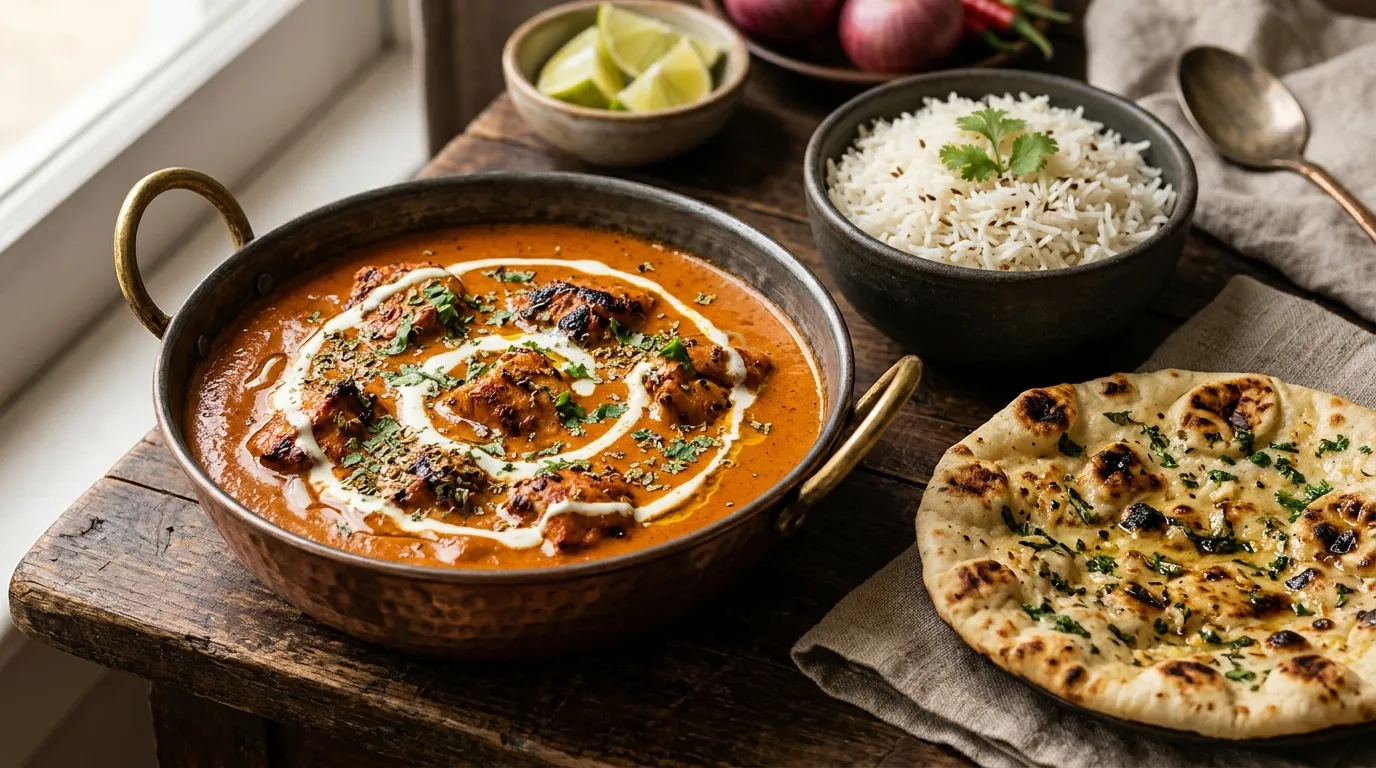
Serve hot with steamed aged basmati rice or blistered garlic naan to swipe up every spoonful of the makhani gravy. For a complete Indian table, pair this dish with our Quick Red Lentil Dahl or explore how Indian spice blooming transforms Dutch winter comfort food in our Indian Spiced Boerenkool Stamppot. You can browse more scratch-cooked international dishes in our World Kitchen Without Packets collection.
- Poultry food safety (75°C core temperature): Always verify with an instant-read thermometer that the thickest piece of chicken thigh reaches a minimum internal temperature of 75°C after simmering in the gravy. Discard any raw yogurt marinade left in the mixing bowl.
- Refrigeration and storage: Transfer leftovers to a shallow container so they cool within 2 hours, then cover tightly and refrigerate at or below 4°C for up to 3 days. Like most slow-spiced curries, the cardamom and kasoori methi aromatics meld even deeper overnight.
- Freezing and reheating: Because soaked cashews stabilize the emulsion, this gravy freezes much more cleanly than cream-only sauces (up to 3 months at -18°C). Thaw overnight in the fridge and reheat gently over low heat in a covered saucepan with a tablespoon of water until piping hot throughout (at least 75°C), avoiding a rolling boil.
Frequently Asked Questions (FAQ)
1. What is the difference between Butter Chicken and Chicken Tikka Masala? While both dishes feature charred marinated chicken in a creamy tomato sauce, their origins and flavor profiles differ clearly. Butter Chicken (Murgh Makhani) originated in 1950s Old Delhi: its sauce is blended completely smooth (and traditionally strained), uses minimal onion, and highlights cultured butter, sweet tomato, green cardamom, and kasoori methi. Chicken Tikka Masala features a chunkier, more assertive gravy built on plenty of browned onions, coriander seed, cumin, and sharper chili heat.
2. Can I make this using leftover Air Fryer Tandoori Chicken? Yes—in fact, that is exactly how Murgh Makhani was invented at Moti Mahal. If you have cooked leftovers from our Air Fryer Tandoori Chicken, cut the meat into bite-sized pieces and warm it gently in the blended makhani gravy in Step 7 for 4 to 5 minutes until the core temperature reaches 75°C again.
3. Can I make Butter Chicken dairy-free or vegan? Yes. Replace the Greek yogurt in the marinade with thick unsweetened coconut yogurt or soy skyr, swap the dairy butter for plant-based block butter, and replace the 100 ml heavy cream with full-fat coconut cream or barista oat cream. Because the 25 grams of soaked cashews provide the primary structural emulsion, the sauce retains its signature velvety body even without dairy.
4. Do I really need to strain the blended sauce through a sieve? Even a high-powered blender leaves behind tiny flecks of cardamom hull, ginger fiber, and onion skin. Pressing the blended sauce through a fine-mesh sieve for 60 seconds is what gives restaurant makhani gravy its satin, mirror-smooth mouthfeel. On a busy weeknight, you can skip straining—just be sure to fish out the whole cardamom pods, cloves, and cinnamon stick before blending.
Watch the step-by-step video
External video demonstration supporting the cooking technique. Smaakkade selects relevant culinary demonstrations to complement our source research; follow the written quantities and steps above for this recipe.
Research-led international recipe adapted for kitchens in the Netherlands
Smaakkade is a research-led food publication. For this dish, we cross-referenced trustworthy culinary sources and step-by-step demonstrations, then adapted the method for kitchens in the Netherlands: with metric weights, clear heat cues, and practical guidance on Dutch supermarket substitutes versus specialty toko ingredients.
Bron / Source: https://smaakkade.nl/en/recipes/authentic-butter-chicken