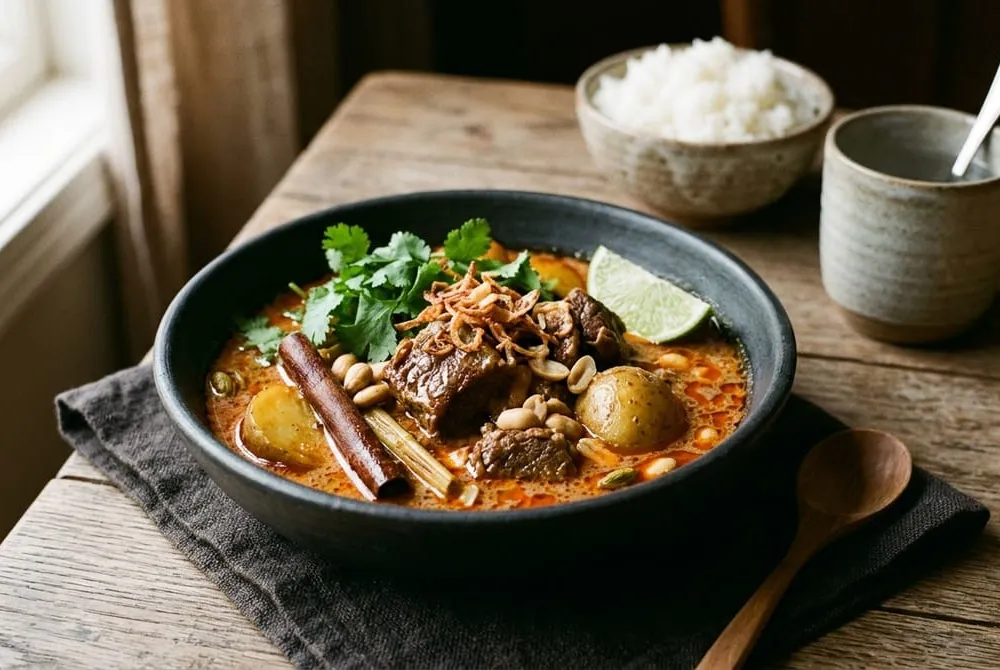
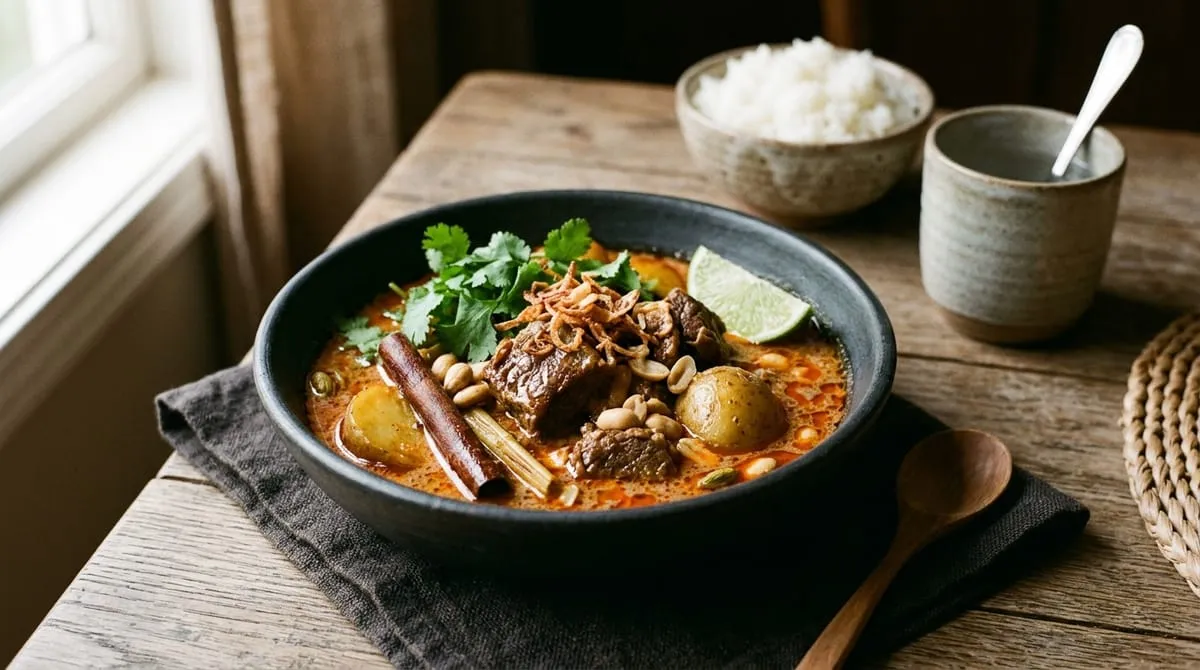
Take one spoonful of authentic Thai Massaman curry (Gaeng Massaman, แกงมัสมั่น) and you immediately realize it behaves nothing like the fiery green or red curries of central Thailand. Where green curry is built on raw green bird’s eye chilies, cilantro root, and makrut lime leaves, Massaman is velvety, nutty, gently sweet-and-tangy, and perfumed with warm spices. There is a fascinating historical reason for that: the dish originated in the 17th-century royal court of Ayutthaya through Persian and Indian spice traders (the word Massaman is an old Thai adaptation of Mussulman, meaning “Muslim”).
For a kitchen in the Netherlands, Massaman might be the single greatest international braise you can cook. Why? Because its three structural pillars are ingredients every Dutch supermarket already excels at: well-marbled braising beef (sukadelappen), waxy Dutch potatoes, and roasted peanuts. Yet if you use a bland supermarket meal kit or simply stir curry paste into cold coconut milk, you miss the entire soul of the dish: the bloomed Persian-Indian spices, the “cracked” coconut cream, and the three-way tension between caramel palm sugar, savory fish sauce, and fruity-tart tamarind paste.
Why Massaman Curry Is Unique: Where Persia & India Meet Thailand
What makes Massaman culinarily extraordinary is its dual-foundation curry paste, which bridges two spice traditions that rarely share the same pot:
- Dry-Toasted Persian & Indian Whole Spices: Cinnamon, green cardamom, cloves, cumin seed, coriander seed, and nutmeg. These warm spices hold fat-soluble aroma compounds that only wake up when toasted dry and fried in hot oil.
- Wet Thai Aromatics (Kroeung / Bumbu): Fresh lemongrass (sereh), galangal (laos), shallots, garlic, mild dried red chilies, and a touch of toasted shrimp paste (trassi / kapi).
The Smaakkade Kitchen Strategy: Toko Paste + The 2-Minute Spice Boost
Pounding a traditional Massaman paste from scratch in a granite mortar takes 30 minutes of serious elbow grease. Fortunately, Thai export tubs from Mae Ploy and Aroy-D (sold at every Asian grocer in the Netherlands and larger Albert Heijn stores) already contain real lemongrass, galangal, shallots, and dried chilies. What pre-made paste does lose sitting on the shelf are the volatile top notes of freshly ground cardamom, cinnamon, cumin, and coriander. That is why we use the Smaakkade Spice Boost: we fry the curry paste in separated coconut oil together with ½ teaspoon of trassi, freshly ground coriander, cumin, and nutmeg, and simmer the beef with bruised whole green cardamom pods and a cinnamon stick. (Only have a jar of standard Thai red curry paste in the cupboard? This exact spice boost plus 1.5 tablespoons of smooth peanut butter transforms red curry paste into a remarkably authentic Massaman base in two minutes!).
The 3 Techniques That Separate Restaurant Massaman from Watery Coconut Soup
1. Do NOT Shake Your Can of Coconut Milk: “Cracking the Coconut Cream” (กะทิแตกมัน)
This is the cornerstone technique of traditional Thai curry cookery, championed by chef Pailin Chongchitnant (Hot Thai Kitchen). Stand your first can of full-fat coconut milk (at least 17–18% fat, such as Aroy-D or Kara) upright on the counter for an hour before cooking and do not shake it. When you pop the lid, you will find a thick, snow-white layer of coconut cream at the top, with thinner coconut water underneath.
- Why we separate them: Scoop only that thick top cream into your Dutch oven over medium-high heat and let it bubble for 3 to 5 minutes until the water evaporates and the emulsion splits (pecah minyak in Indonesian, just like in our Authentic Beef Rendang). Once clear droplets of coconut oil pool in the pan, add the Massaman paste and fry it directly in that natural coconut fat.
2. Braise the Beef First, Add the Dutch Potatoes for the Final 35 Minutes
Dutch sukadelappen (chuck steak) need roughly 1 hour and 45 minutes of gentle simmering for the collagen to melt into fork-tender silk; potatoes cook through in 30 to 35 minutes. If you throw the potatoes in at the beginning with the raw beef, they will disintegrate into mush long before the meat is tender.
- Which Dutch potato should you buy? Pick a waxy or slightly floury potato (vastkokend or licht kruimig) from Albert Heijn or Jumbo, such as Nicola, Bildtstar, or Celeste. Cut them into generous
3.5 cmchunks and add them during the final35 minutesalongside the onion wedges.
3. The Essential Three-Way Finish: Tamarind + Palm Sugar + Fish Sauce
Without acidity, a rich coconut-and-peanut curry tastes heavy and cloying. Unlike green curry, however, you never use fresh lime juice in Massaman (its sharp floral citrus clashes with cinnamon, cloves, and cardamom). The signature tang in Massaman comes strictly from tamarind paste: its dark, dried-fruit tartaric acidity weaves seamlessly into the caramel notes of palm sugar and the savory depth of fish sauce.
Protein Timing Matrix: Slow Beef Braise vs. 35-Minute Chicken Thighs or Tofu
Short on time on a weeknight? Here is how to adapt the exact same Massaman sauce for fast proteins:
| Protein Choice | Cut & Quantity | Total Simmer Time | When to Add the Potatoes |
|---|---|---|---|
| 1. Dutch Braising Beef (Sukadelappen / Riblappen) (Classic) | 700 g in generous 4 x 4 cm cubes |
1 hr 45 min on the lowest simmer | After 70 minutes of braising (simmer for the final 35 min with onions). |
| 2. Boneless Chicken Thighs (Kippendijfilet) (35-Min Weeknight Fast-Track) | 600 g chicken thighs cut into 4 cm chunks |
30 – 35 minutes total | Right from the start together with the chicken so both finish at the same time! |
| 3. Crispy Air Fryer Tofu & Chickpeas (100% Vegan) | 400 g crispy tofu cubes + 1 can drained chickpeas |
30 minutes for the potatoes & chickpeas | Simmer the potatoes and chickpeas for 30 min; fold in the crispy tofu during the final 3 minutes. |
Step-by-Step Instructions
Step 1: Toast the peanuts and bruise the whole aromatics
Heat a dry skillet over medium-low heat and toast the 75 g peanuts for 4 to 5 minutes, shaking the pan frequently until golden spots appear and they smell nutty. Transfer to a plate. Using the flat side of a chef’s knife or a pestle, lightly crush the 5 green cardamom pods just enough to crack the husks, and bash the lower white ends of the 2 lemongrass stalks to release their essential oils. Slice the 3 cm piece of fresh galangal into 4 thick coins.
Step 2: Scoop and “crack” the thick coconut cream (5 minutes)
Open the first can of full-fat coconut milk (400 ml) without shaking it. Spoon the thick white cream layer from the top (about 150 to 200 ml) into a heavy Dutch oven (braadpan) over medium-high heat.
Let the cream bubble steadily for 3 to 5 minutes, stirring occasionally, until the water evaporates and shiny puddles of clear coconut oil separate from the solids. (If your coconut milk contains guar gum and refuses to split, simply drizzle in 1 tablespoon of neutral cooking oil).
Step 3: Fry the Massaman paste, trassi & ground spices in the coconut oil (3 minutes)
Lower the heat to medium-low. Add the 4 tbsp Massaman curry paste, ½ tsp trassi (shrimp paste) (or 1 tsp red miso for vegan), 1 tsp ground coriander, ½ tsp ground cumin, and ¼ tsp grated nutmeg directly into the cracked coconut cream.
Stir-fry continuously for 2 to 3 minutes until the paste darkens a shade, smells intensely aromatic, and droplets of reddish-orange oil glisten around the edges. Stir in the 1.5 tbsp smooth 100% peanut butter until melted into the paste.
Step 4: Simmer the beef with whole spices and peanuts (70 minutes)
Add the 700 g cubed beef (sukadelappen) to the pot and toss for 1 minute to coat every piece in the fragrant spice paste. Pour in the remaining thin coconut milk from the first can, the entire second can of coconut milk (400 ml), and 150 ml water (or low-sodium beef stock). Add the bruised lemongrass stalks, galangal coins, cinnamon stick, 5 bruised cardamom pods, 3 cloves, 2 bay leaves, the toasted peanuts (save a small handful for garnish), and 1 tablespoon fish sauce. (Simmering the peanuts in the curry softens them into buttery bites that infuse the gravy). Bring to a gentle bubble, set the lid slightly ajar, and simmer on the lowest burner setting for 70 minutes. (Using chicken thighs instead of beef? Skip this 70-minute stage and proceed straight to Step 5!).
Step 5: Add the Dutch potatoes and onion wedges (35 minutes)
After 70 minutes of braising the beef (or immediately if using chicken thighs), add the 450 g potato chunks and onion wedges to the pot. Submerge them in the liquid and simmer uncovered over low heat for 30 to 35 minutes until both the beef and potatoes are fork-tender and the gravy has reduced to a glossy, spoon-coating consistency.
Step 6: Balance with the Thai triad (Tamarind, Palm Sugar & Fish Sauce)
Stir in the 2 tbsp tamarind paste, 2 tbsp palm sugar (or dark brown caster sugar), and the remaining 1 to 1.5 tbsp fish sauce. Simmer gently for 2 minutes until the sugar dissolves completely, then taste! Authentic Massaman should hit savory, creamy, and nutty notes first, followed immediately by warm caramel sweetness and a bright, fruity tamarind tang at the finish. Remove the cinnamon stick, lemongrass stalks, and galangal coins if desired, scatter with the reserved toasted peanuts, and serve over steaming jasmine rice.
Frequently Asked Questions About Thai Massaman Curry (FAQ)
1. Is Massaman curry spicy compared to Thai red or green curry?
Massaman is naturally the mildest and gentlest of all Thai curries. Whereas Thai green curry uses 15 to 20 fiery fresh bird’s eye chilies (rawit), Massaman uses only a few large, mild dried red chilies for warm color and a gentle background glow. That makes it a crowd-pleasing centerpiece for kids and spice-sensitive guests.
2. How is Thai Massaman curry different from Indonesian Beef Rendang?
Although both dishes feature braised beef, coconut milk, lemongrass, galangal, and warm spices, they differ in three key ways:
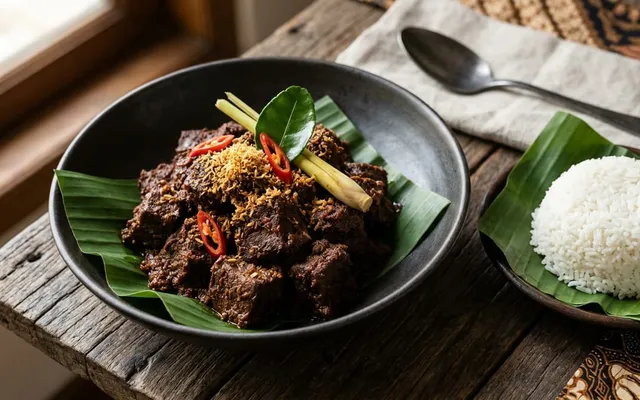
- Indonesian Beef Rendang is reduced until almost completely dry so the meat fries in its own separated coconut oil and toasted coconut (kelapa sangrai); Massaman remains a generous, spoonable gravy curry cooked with potatoes.
- Massaman relies on roasted peanuts and green cardamom as signature aromatics.
- Massaman has a pronounced sweet-sour-savory balance driven by palm sugar, tamarind, and fish sauce.
3. How can I make this Massaman curry 100% vegetarian or vegan?
First, check the label on your curry paste tub: both Aroy-D and Mae Ploy Massaman curry pastes sold in the Netherlands are actually made without shrimp paste and are 100% vegan out of the tub. Omit the extra ½ teaspoon of trassi (or swap in 1 teaspoon of red miso), replace the fish sauce with soy sauce or our vegan fish sauce substitute, and use potatoes, chickpeas, and Crispy Air Fryer Tofu.
4. Can you make Massaman curry a day ahead (and can you freeze it)?
Just like our Dutch Fusion Beef Stew and Beef Rendang, Massaman curry tastes even better the next day once the cardamom, cinnamon, and tamarind have permeated the meat and potatoes. It keeps in the fridge for 3 to 4 days.
- Freezer tip: The braised beef and coconut-peanut gravy freeze beautifully for up to 3 months, but boiled potato chunks turn mealy and watery when thawed. If freezing a batch, either freeze the beef and sauce before adding the potatoes, or pick out the potato chunks before freezing.
Watch the step-by-step video
External video demonstration supporting the cooking technique. Smaakkade selects relevant culinary demonstrations to complement our source research; follow the written quantities and steps above for this recipe.
Research-led international recipe adapted for kitchens in the Netherlands
Smaakkade is a research-led food publication. For this dish, we cross-referenced trustworthy culinary sources and step-by-step demonstrations, then adapted the method for kitchens in the Netherlands: with metric weights, clear heat cues, and practical guidance on Dutch supermarket substitutes versus specialty toko ingredients.
Bron / Source: https://smaakkade.nl/en/recipes/thai-massaman-curry