
Miso (Japanese Miso Paste)
Shiro, Awase & Aka Miso · Fermented soybean and koji paste (味噌)
Out of white or red miso paste for soup, ramen, glazes, or dressings? Use our 5 ranked miso substitutes with exact ratios, plus shiro vs. aka miso in the Netherlands.

At a Glance: Where to Buy or Substitute
Netherlands Pantry GuideAvailability in the Netherlands
White and dark miso pouches or jars at Albert Heijn and Jumbo (Saitaku, ItSU) and Ekoplaza (Terrasana, pasteurized); unpasteurized chilled tubs (500 g to 1 kg) in the refrigerator case at Asian supermarkets / tokos (Amazing Oriental, Wah Nam Hong, Tjin's Toko — Hikari Miso, Marukome, Sempio).
Best Direct Substitute
2 tsp white tahini + 1 tsp soy sauce (for thick glazes, miso butter & dressings) OR 1.5 tsp soy sauce + ½ tsp mirin (for broths, ramen & soup)
You are halfway through prepping a tray of roasted eggplant, whisking a sesame-miso salad dressing, or balancing the spicy gochujang sauce for Korean Bibimbap when you discover your pouch of white miso paste is empty. Or perhaps you are standing in front of the Asian aisle at Albert Heijn, Ekoplaza, or Amazing Oriental staring at tubs labeled Shiro Miso (white), Shinshu Miso (yellow), Aka Miso (red), and Mugi Miso (barley), wondering whether you can swap one for another 1-to-1.
Be careful with the lazy advice repeated across half the internet: “Just replace 1 tablespoon of miso with 1 tablespoon of soy sauce.” While that shortcut works in a big pot of noodle broth, it will ruin a glaze for Air Fryer Teriyaki Salmon, break a compound miso butter, and turn a creamy dressing watery. Soy sauce is a thin, high-sodium liquid with none of the emulsifying bean fibers or mellow rice-koji sweetness that give miso its thick, velvety body.
In this guide, we explain what miso does chemically and culinarily in your pan, the exact difference between white, yellow, and red miso on Dutch shelves, why miso soup should never boil above 85 °C, and the five best substitutes ranked by dish—complete with exact ratios and soy/gluten allergy notes.
What Is Miso Paste and How Does It Build Umami?
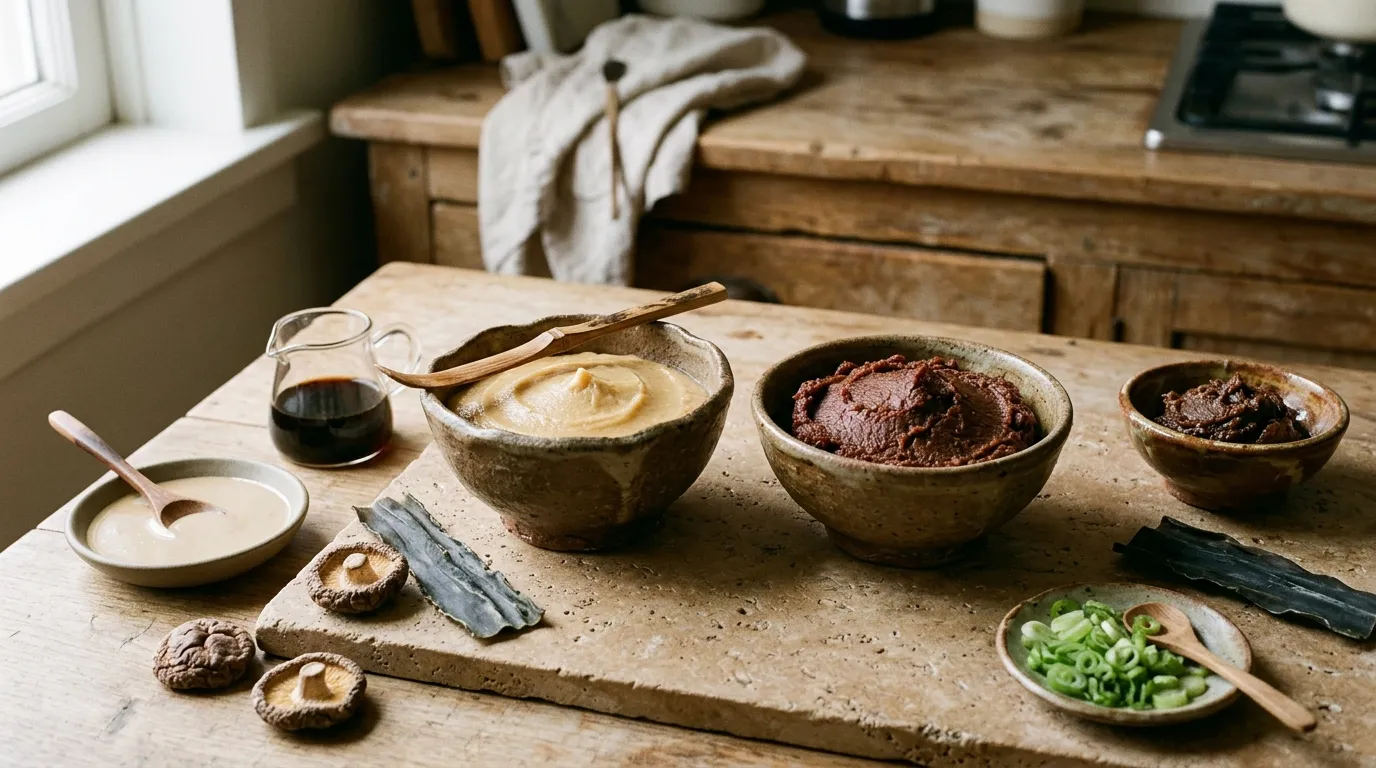
Miso (味噌) is a traditional Japanese fermented seasoning paste made from three foundational ingredients: cooked soybeans, sea salt, and a grain (most commonly white rice or barley) inoculated with the beneficial mold Aspergillus oryzae—known in Japan as koji (麹).
During a fermentation period ranging from a few weeks to up to three years, natural enzymes produced by the koji culture break down complex molecules inside the soybeans and grain:
- Protease enzymes cleave soybean proteins into free amino acids, generating high concentrations of natural glutamic acid (glutamate). That is the source of miso’s deep, savory umami backbone.
- Amylase enzymes convert rice or barley starches into simple sugars (glucose and maltose). The higher the ratio of rice koji and the shorter the fermentation, the sweeter, paler, and milder the miso tastes.
- Natural emulsification and thickening: Because miso is a dense puree of finely milled soybean fibers and proteins, it binds oil and water in dressings, marinades, and pan sauces the exact same way mustard or tahini (sesame paste) does.
White vs. Yellow vs. Red Miso: The Complete Comparison Table
Before substituting miso—or grabbing a random jar off the shelf—you need to know which style your recipe expects. A tablespoon of dark red miso contains roughly twice the salt of a tablespoon of white miso and behaves completely differently in a delicate sauce:
| Feature | White Miso (Shiro Miso / 白味噌) | Yellow or Mixed Miso (Shinshu / Awase / 合わせ味噌) | Red / Dark Miso (Aka Miso / 赤味噌) |
|---|---|---|---|
| Soybean vs. Rice-Koji Ratio | High rice koji (up to 60%), lower soybeans | Balanced ratio of soybeans and rice koji (or a blend of white and red miso) | High soybeans (70–100%), low rice or barley koji |
| Fermentation Time | Short: 2 to 8 weeks | Medium: 3 to 6 months | Long: 1 to 3 years (slow Maillard reactions turn the paste deep russet to chocolate-brown) |
| Salt Content | Low: approx. 5 to 6% salt | Medium: approx. 8 to 10% salt | High: approx. 11 to 13% salt |
| Flavor Profile | Mild, creamy, lightly sweet, gently savory, almost buttery | All-purpose savory, clean fermented tang, balanced saltiness | Bold, earthy, roasted, assertively salty, and intensely umami |
| Best Culinary Use | Salad dressings, miso butter, salmon/eggplant glazes, light soups, desserts | Everyday miso soup, ramen tare, stir-fry sauces, and marinades | Hearty winter stews, braises, rich meat glazes, dark aka ramen |
Smaakkade Kitchen Tip: Whenever a Western or Dutch recipe simply calls for “1 tablespoon miso paste” without specifying a color, the author means white miso (shiro miso) or mild yellow miso 90% of the time. Never substitute dark red miso (aka miso) 1-to-1 in a light dressing or fish glaze without adjusting the ratio, or the salt and fermented intensity will overwhelm the dish.
The 85 °C Rule: Why You Never Boil Miso Soup (Wait—What About Roasting?)
Home cooks often hear two seemingly contradictory rules about heating miso: “Never boil miso” and “Roast miso-glazed eggplant at 200 °C.” Both rules are right, for completely different chemical reasons:
- In miso soup and broths (keep below
85–90 °C): Much of the delicate, floral, fruity aroma of good miso lives in volatile aromatic compounds (esters and alcohols created during koji fermentation). If you boil miso soup vigorously at100 °C, those volatile aromatics evaporate right out of the pot with the steam, leaving behind a flat, salty broth. Furthermore, unpasteurized miso from the chilled toko aisle contains live lactic-acid bacteria and active enzymes that die above50–60 °C. For soup, always turn off the heat first, then dissolve the miso in a ladleful of warm broth through a fine-mesh strainer right before serving. - In oven and air-fryer glazes (high heat
180–200 °Cis the goal): When brushing a mixture of white miso, mirin, and sugar onto roasted eggplant (nasu dengaku), Crispy Air Fryer Tofu, or salmon, you are not trying to preserve delicate soup aromatics—you are deliberately triggering the Maillard reaction, where miso’s free amino acids react with mirin’s sugars under high heat to create a deeply caramelized, savory crust.
The 5 Best Miso Substitutes (Ranked by Culinary Role)
Because miso simultaneously contributes salt + umami + fermented sweetness + creamy paste body, the best substitute depends on whether you are making a thick glaze/dressing or a liquid broth:
Quick-Reference Conversion Table
| Substitute | Ratio (per 1 tbsp miso) | Best Culinary Application | Allergen Status |
|---|---|---|---|
| 1. White Tahini + Soy Sauce (or Tamari) | 2 tsp white tahini + 1 tsp soy sauce + ½ tsp honey/mirin | Salad dressings, miso butter, oven glazes (eggplant/salmon), creamy sauces | Contains sesame & soy (gluten-free with tamari) |
| 2. Soy Sauce (or Tamari) + Mirin | 1.5 tsp soy sauce + ½ tsp mirin (or a pinch of sugar) | Miso soup, ramen broth, stews, and liquid stir-fry sauces | Contains soy (sesame- & nut-free) |
| 3. Korean Doenjang or Gochujang | 1 tbsp doenjang (for red miso) OR ¾ tbsp gochujang (spicy) | Korean and Japanese stews, Korean Bibimbap, spicy marinades | Contains soy & often wheat/gluten |
| 4. Swapping White Miso ↔ Red Miso | 1.5 tbsp white miso (for 1 tbsp red) OR ½ tbsp red + ½ tsp mirin (for 1 tbsp white) | Any recipe when you already have the other color of miso in the fridge | Contains soy (check label for barley/gluten) |
| 5. Fish Sauce OR Nutritional Yeast + Cashew Butter | 1.5 tsp fish sauce OR 1 tsp nutritional yeast + 2 tsp cashew butter + pinch of salt | Broths, curries, and 100% soy-free recipes | Soy-free (fish sauce contains fish; nutritional yeast is 100% vegan) |
1. Best for Glazes, Miso Butter & Dressings: White Tahini + Soy Sauce
Does your recipe call for white miso in a creamy vinaigrette, a broiled glaze for roasted cauliflower, eggplant, or salmon, or whipped into softened butter for miso butter?
- Why it works: Plain soy sauce is far too runny to cling to roasted vegetables and will split softened butter. By blending pourable white Levantine tahini (sesame paste) with naturally brewed soy sauce and a touch of mirin or honey, you replicate both the thick, emulsifying paste texture and the nutty, savory-sweet profile of white miso with remarkable accuracy.
- Exact ratio (per 1 tablespoon white miso): Whisk together 2 teaspoons white tahini + 1 teaspoon Japanese soy sauce (or gluten-free tamari) + ½ teaspoon mirin or honey. For a salad dressing, add 2 drops of rice vinegar to mimic miso’s subtle lactic tang.
2. Best for Soups, Ramen & Broths: Soy Sauce (or Tamari) + Mirin
Making a pot of ramen broth like our Quick 25-Minute Miso Ramen, udon noodle soup, mushroom broth, or a saucy stir-fry where the miso dissolves completely into a larger volume of liquid? (Tip: dark miso also works in reverse as the single best 100% plant-based substitute when you need a trassi / shrimp paste substitute in an Indonesian bumbu!).
- Why it works: In a broth, you do not need the thickening fibers of the soybean paste—you only need fermented soy umami, salt, and a whisper of rice sweetness. Naturally brewed Japanese soy sauce (shoyu) is fermented with the exact same Aspergillus oryzae (koji) culture as miso.
- Exact ratio (per 1 tablespoon miso): Use 1.5 teaspoons Japanese soy sauce (or tamari) + ½ teaspoon mirin (or ¼ teaspoon sugar). Never swap soy sauce 1-to-1 by volume for miso: soy sauce is roughly 14 to 16% salt compared to 6 to 12% in miso.
3. Best Fermented Soybean Match: Korean Doenjang or Gochujang
If your fridge is stocked for Korean cooking like Korean Bibimbap or Korean Fried Chicken from the Air Fryer, you already have a close relative of miso on hand:
- Doenjang (brown tub): Korean doenjang (된장) is the direct cousin of Japanese red/dark miso (aka miso). It is a rustic, assertive fermented soybean paste with deep earthy umami. Replace 1 tablespoon red or dark miso 1-to-1 with 1 tablespoon doenjang (to replace white miso, use ½ tablespoon doenjang + ½ teaspoon sugar or mirin).
- Gochujang (red tub): Making a savory marinade, braise, or stir-fry sauce where gentle chili heat is welcome? Replace 1 tablespoon miso with ¾ tablespoon gochujang + a tiny pinch of salt. Because gochujang is fermented with glutinous rice koji and soybeans, it provides the same glossy body and savory depth alongside warm chili heat.
4. Swapping White Miso for Red Miso (and Vice Versa)
Have a tub of dark red miso in the fridge when a recipe calls for white miso—or the other way around? Use these scaling rules so the salt level stays balanced:
- You only have RED miso, and the recipe calls for 1 tbsp WHITE miso: Use ½ tablespoon red miso + ½ teaspoon mirin (or honey/sugar) + 1 teaspoon water (or unsalted butter/tahini). That cuts the heavy saltiness in half and restores the missing koji sweetness.
- You only have WHITE miso, and the recipe calls for 1 tbsp RED miso: Use 1.5 tablespoons white miso + ½ teaspoon dark soy sauce, and slightly reduce any extra sugar in the recipe.
5. Best Soy-Free Substitute: Nutritional Yeast + Cashew Butter OR Fish Sauce
Cooking for someone with a soy allergy? Miso, soy sauce, tamari, doenjang, and gochujang are all off the table since every one of them is fermented from soybeans.
- Plant-based & 100% soy-free (for creamy sauces, dressings & soups): Per tablespoon of miso, blend 1 teaspoon nutritional yeast flakes (edelgistvlokken) + 2 teaspoons 100% cashew butter (or sunflower seed butter) + ¼ teaspoon fine sea salt + 1 teaspoon warm water. Nutritional yeast is packed with natural glutamates that mimic miso’s savory depth.
- For stews and broths (non-vegetarian, soy-free): Replace 1 tablespoon miso with 1.5 teaspoons Asian fish sauce (nam pla) or ½ teaspoon concentrated mushroom bouillon paste.
Allergy & Label Check: Is Miso Gluten-Free?
When buying or substituting miso in the Netherlands, check two allergens on the label:
- Soy (Always present in standard miso): Traditional white, yellow, and red miso are all made from soybeans. Only specialty chickpea miso (occasionally sold at organic health-food stores) is soy-free.
- Gluten (Crucial difference between Kome Miso and Mugi Miso):
- White and red rice miso (Kome Miso) and pure soybean miso (Hatcho Miso) are fermented with rice koji or soybeans alone and are naturally gluten-free (always verify the label for cross-contamination or wheat-derived alcohol).
- Barley miso (Mugi Miso)—a very common dark jar sold in Dutch organic supermarkets like Ekoplaza under brands like Terrasana—is fermented with barley (gerst) and therefore contains gluten. If cooking for someone with celiac disease or gluten sensitivity, always pick a rice-based Shiro Miso or Genmai Miso (brown-rice miso) with a certified gluten-free mark.
Buying and Storing Miso in the Netherlands
- Supermarket vs. Toko (Watch out for instant soup sachets!): In the Asian aisle of Albert Heijn and Jumbo, brands like Saitaku and ItSU sell two very different products side by side: pure miso paste (in a resealable spout pouch or glass jar) and instant miso soup sachets (small single-serve liquid or freeze-dried packets that already contain dashi stock, dried wakame seaweed, and tiny tofu cubes). For glazes, marinades, and dressings, always buy pure miso paste. For the best flavor and value, visit an Asian supermarket (see our Dutch Toko & World Grocer Finder) and grab a 500 g chilled tub of unpasteurized Hikari Miso or Marukome from the refrigerator case—it costs half as much per gram as supermarket pouches and has far brighter fermentation aromatics.
- The parchment-paper storage trick: Thanks to its salt content and fermentation, an opened tub of miso keeps in the refrigerator for 6 to 12 months. Do not throw away the thin piece of parchment or plastic film resting directly on top of the paste inside a new tub (or press a fresh piece of baking paper or plastic wrap directly against the surface before snapping the lid shut). Keeping air off the surface prevents the top layer from drying into a dark crust in the fridge.
Frequently Asked Questions About Substituting Miso (FAQ)
Can I substitute soy sauce 1-to-1 for miso paste?
No—always use half the volume (1.5 teaspoons soy sauce per 1 tablespoon miso) and only use plain soy sauce as a substitute in soups, broths, or liquid stir-fry sauces. Soy sauce is significantly saltier than white miso and has zero thickening body. For glazes, marinades, or dressings, always pair the soy sauce with white tahini or cashew butter to restore the paste texture.
How long does an opened tub or pouch of miso last in the fridge?
White miso (shiro miso) has less salt and more residual sugar; keep an opened pouch or tub refrigerated and use it within 6 to 9 months. Dark red miso (aka miso) and barley miso (mugi miso) contain much more salt and easily keep for 1 to 2 years in the refrigerator. If the paste darkens slightly around the edges over several months, it is still safe—that is simply slow, ongoing Maillard aging.
Can you freeze miso paste?
Yes! Freezing is one of the best kitchen tricks for miso: because of its salt, sugar, and low free-water content, pure miso paste does not freeze solid in a standard -18 °C home freezer. You can scoop spoonfuls straight from the freezer tub whenever you need them, and freezing locks in the pale color and sweet aroma of white miso for well over a year.
Is all miso paste vegan?
Pure miso paste (soybeans, rice or barley, salt, and water) is 100% plant-based and vegan. However, watch out for Japanese tubs labeled Dashi-iri Miso (だし入り味噌, “miso with added dashi”) as well as instant miso soup packets: those are pre-seasoned with katsuobushi (dried skipjack tuna flakes) or anchovy extract so they can be dissolved in plain hot water without making stock. Always check the ingredient list if cooking vegan or vegetarian.
Recipes Using Miso (Japanese Miso Paste)
Quick 25-Minute Miso Ramen From Scratch (Sapporo Style)
Make creamy restaurant-style Japanese miso ramen in 25 minutes: built with a velvet miso-tahini tare, 6.5-minute jammy ramen eggs, and Dutch supermarket staples.
Korean Bibimbap (Smart 1-Pan Method & Crispy Skillet Rice Crust)
Make authentic Korean bibimbap at home without 5 pans of dishes: featuring our 1-pan namul sequence, cast-iron crispy rice crust (nurungji), and gochujang sauce.
Air Fryer Teriyaki Salmon (With Homemade Mirin Glaze)
Silky air fryer teriyaki salmon in 20 minutes: with a glossy homemade mirin-soy glaze, exact timing by fillet thickness, and a 10-minute brine to prevent white albumin.
Crispy Air Fryer Tofu
Golden brown, shatteringly crisp on the outside, and silky on the inside. This is the only tofu method you'll ever need — featuring the cornstarch trick that changes everything.
Video Guide & Culinary Context
More Ingredient Guides

Gochujang
The complete guide for expats: exactly what gochujang is, where to buy it in the Netherlands, and how to replace it when you're out.
Rice Vinegar (Japanese & Asian Rice Vinegar)
Out of rice vinegar? Discover the 5 best substitutes (like apple cider vinegar + sugar), how it differs from sushi vinegar and mirin, plus a DIY sushi-zu ratio.

Fish Sauce
The complete guide: what fish sauce is, why it smells like that but tastes divine, and how to substitute it if you're cooking vegetarian or vegan.