When a craving for a steaming bowl of homemade ramen hits on a rainy Tuesday evening in the Netherlands, most home cooks face two unappealing options: tear open a deep-fried packet of instant noodles with a sodium-bomb seasoning sachet, or read a purist recipe that insists you simmer pork bones for 16 hours. Worse yet, if you follow a typical Western “quick ramen” recipe that boils a stock cube, a splash of soy sauce, and raw noodles together in a single pot, you end up with a cloudy, watery salt soup that tastes nothing like a real ramen shop.
Fortunately, northern Japan solved this exact problem back in the 1950s in snowbound Hokkaido with Sapporo-style Miso Ramen. Unlike tonkotsu (which relies on emulsified bone collagen), miso ramen builds its velvety body and deep umami from a sizzled aromatic base and an emulsified miso-tahini tare. That means you can put a rich, restaurant-caliber bowl of miso ramen on the table in 25 minutes flat.
The Secret to 25-Minute Miso Ramen: The 3-Layer Ramen Architecture
In a Japanese ramen-ya, a bowl of ramen is never just “seasoned soup.” It is assembled from three distinct building blocks that work together:
1. The Sizzled Aromatic Base & Aroma Oil
Instead of starting with cold water in a pot, you first sear grated garlic, fresh ginger, scallion whites, and minced chicken/pork (or finely chopped shiitake mushrooms for a vegetarian bowl) in toasted sesame oil with a teaspoon of fermented gochujang (or Chinese doubanjiang). The fat in the sesame oil extracts fat-soluble aromatics from the garlic, ginger, and chili, creating the glossy aroma oil layer that floats on top of the broth and coats every strand of noodle as you lift it from the bowl.
2. The Miso-Tahini Tare (The 60-Second Trick for Creamy Body)
Here is the secret that turns a thin weeknight broth into a luxurious, opaque soup: we whisk miso paste together with mirin, soy sauce, and 1 tablespoon of white tahini (or Japanese toasted sesame paste, nerigoma).
- Why tahini works like magic: Finely ground sesame seeds are naturally rich in lecithin and emulsifying proteins. The moment you whisk a tablespoon of white tahini and miso paste into hot broth, it forms a stable, creamy micro-emulsion. Your broth immediately gains that velvety, rich mouthfeel without a single drop of heavy cream or hours of boiling bones.
- The golden temperature rule (
<85 °C): Never boil miso paste! Above85 °C, the delicate, floral koji aroma compounds evaporate and the soup tastes flat. Always turn the burner down to its lowest setting before whisking your miso-tahini tare into the pot.
3. The Dutch Stock Cube Trap (Watch Your Sodium!)
The number-one reason homemade miso ramen fails in Dutch kitchens is over-salting. If you dissolve two standard Dutch bouillonblokjes in 800 ml of water and then add 3 tablespoons of miso and 1 tablespoon of soy sauce, the soup will be overwhelmingly salty because European stock cubes are nearly 50% pure salt.
- The Smaakkade rule: In Japanese ramen, the liquid broth (dashi or chicken stock) is practically unsalted; all the salinity comes from the tare (the miso and soy sauce). Use only half (½) a Dutch stock cube per
800 mlof hot water (or use low-sodium liquid stock).
Where to Buy Ingredients in the Netherlands
| Component | Albert Heijn / Jumbo Option | Amazing Oriental / Toko Upgrade |
|---|---|---|
| Miso Paste | Saitaku White Miso or ItSU Miso (Asian aisle) or Terrasana Shiro/Genmai Miso (Ekoplaza). | A 500 g tub of Hikari Awase Miso (blend of white & red miso) or Marukome from the chilled aisle. |
| Ramen Noodles | Dried Saitaku Ramen Noodles or Hakubaku Organic Ramen. (Only have egg noodles? Boil with ½ tsp baking soda!). | Fresh chilled or frozen alkaline ramen noodles (Sun Noodle or Miyako) for authentic springy bite (koshi). |
| White Tahini | Souq Tahini (100% white hulled sesame paste in the Middle Eastern aisle). | Japanese Nerigoma (toasted white sesame paste) or Lebanese Al Yaman tahini. |
| Aromatics | Saitaku Mirin, Kikkoman Soy Sauce, toasted sesame oil, and a tub of Go-Tan or Saitaku Gochujang. | Real Takara Hon Mirin and Sichuan Pixian Doubanjiang (fermented broad-bean chili paste). |
Step-by-Step Instructions (25 Minutes Start to Finish)
Step 1: Boil the 6.5-minute jammy ramen eggs (Start here!)
Bring a small saucepan of water to a gentle boil (deep enough to submerge the eggs). Gently lower the 2 room-temperature eggs into the simmering water with a spoon and set a timer for exactly 6 minutes and 30 seconds for set whites and a custardy, jammy orange yolk. Immediately transfer the eggs to a bowl of ice-cold water for 5 minutes to halt the cooking, then peel carefully starting from the wider base. (Netherlands Voedingscentrum food-safety note: if cooking for pregnant guests, young children, elderly diners, or immunocompromised individuals, boil the eggs for 9 to 10 minutes until the yolks are cooked solid above 70 °C).
Step 2: Whisk the Miso-Tahini Tare in a small bowl
In a small bowl, stir together the 3 tbsp miso paste, 1 tbsp white tahini, 1.5 tbsp mirin, and 1 tbsp soy sauce into a smooth, glossy paste. Set it next to the stove; it goes in at the very end off the boil.
Step 3: Sear the aromatic base in toasted sesame oil (4 minutes)
Heat a deep soup pot or wok over medium-high heat and add 1.5 tbsp toasted sesame oil. Add the 180 g minced chicken or pork/beef mince (or finely chopped shiitake/chestnut mushrooms for vegetarian) and sear for 2 to 3 minutes, breaking it up with a wooden spoon until golden brown and caramelized. Add the 2 finely grated garlic cloves, 1.5 tsp grated fresh ginger, the sliced white parts of the 3 spring onions, and 1 tsp gochujang. Stir-fry for 60 seconds until fragrant. (When using minced meat, ensure it is cooked completely through to a safe internal temperature of at least 70–75 °C).
Step 4: Add the broth & emulsify the Miso-Tahini Tare (Do not boil!)
Pour the 800 ml hot, low-sodium stock (made with only ½ a Dutch stock cube!) into the pot and bring to a gentle simmer. Let bubble softly for 2 minutes so the seared meat and ginger infuse the broth.
Now turn the burner down to its lowest setting so the surface stops bubbling (<85 °C). Ladle 3 tablespoons of hot broth into your bowl of miso-tahini tare, whisk until completely smooth and fluid, then pour the emulsified mixture back into the soup pot. Stir in 1 tsp rice vinegar to brighten the rich sesame-miso base. Taste: the soup should be creamy, deeply savory, and balanced.
Step 5: Boil the ramen noodles and paksoi in a separate pot (3 minutes)
Why do you never boil ramen noodles directly inside your miso broth? Because ramen noodles shed surface starch and alkaline salts (kansui) into the cooking water, which would turn your delicate miso broth cloudy, gummy, and bitter. Bring a separate pot of unsalted water to a rolling boil. Cook the 200 g ramen noodles according to package directions (2 minutes for fresh noodles or 3 to 4 minutes for dried noodles) until just al dente. During the final 60 seconds, drop the halved baby paksoi (or spinach) into the noodle water to blanch briefly. Drain into a colander and shake the colander vigorously up and down three times so clinging cooking water does not dilute your broth.
Step 6: Assemble the bowls like a Japanese Ramen-ya
- Divide the hot, well-drained noodles between 2 large, pre-warmed ramen bowls.
- Ladle the piping-hot, velvety miso broth (along with the savory minced meat or mushrooms) generously over the noodles.
- Use chopsticks or tongs to lift the noodles once and fold them neatly over themselves, creating a flat “raft” that keeps your toppings afloat.
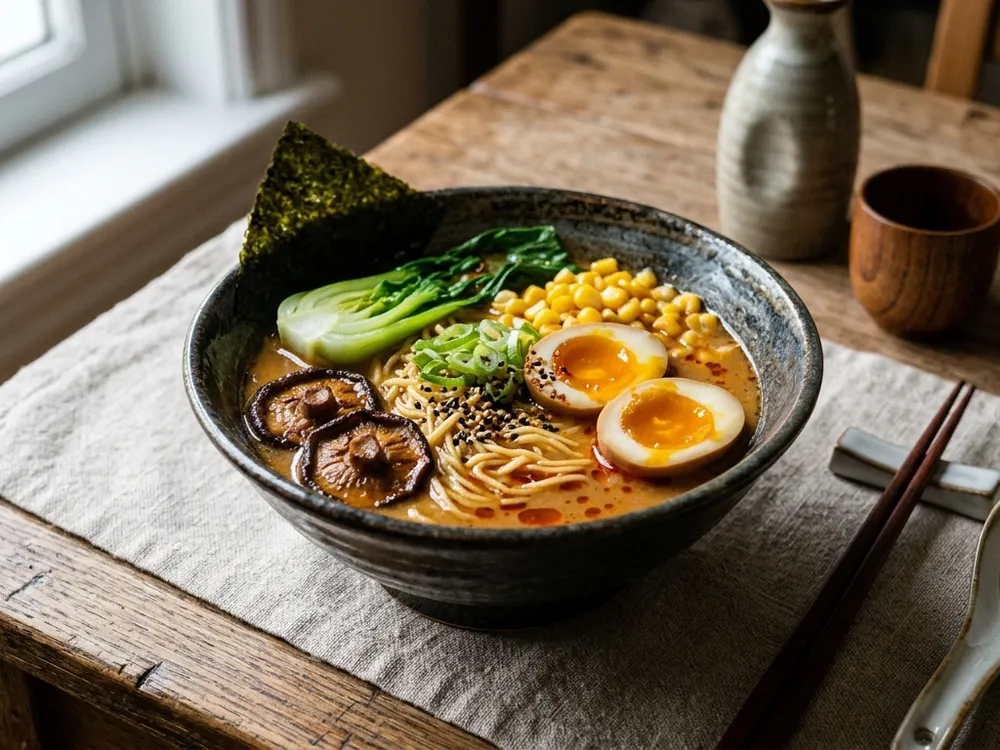
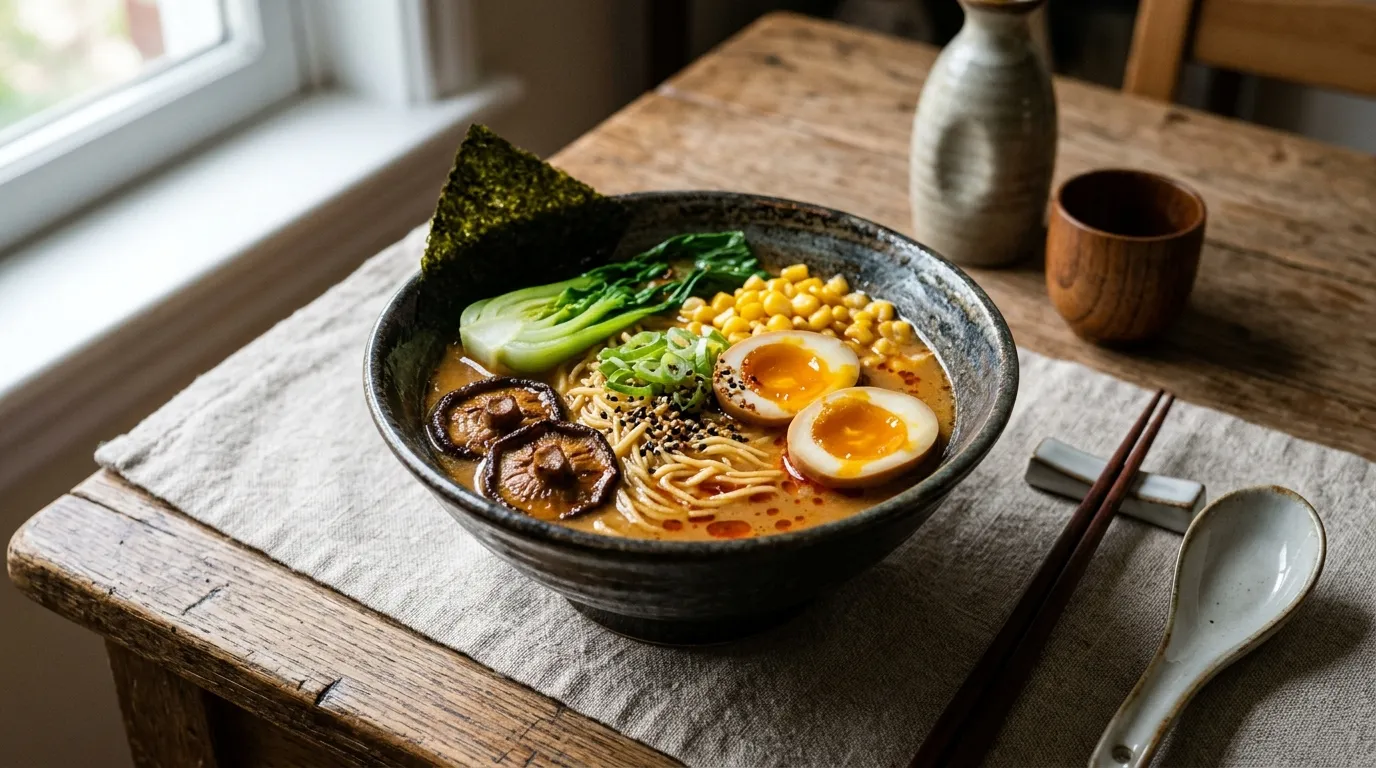
- Arrange the blanched paksoi, a mound of sweetcorn, the sliced green scallion tops, and the halved 6.5-minute jammy ramen eggs on top. Tuck 2 sheets of nori along the rim of the bowl, scatter with toasted sesame seeds, and serve immediately!
Frequently Asked Questions About Making Miso Ramen (FAQ)
1. Which miso is best for miso ramen: white or red miso?
The best flavor comes from blending two styles (awase miso): 2 tablespoons white miso (shiro miso) for creamy, mellow koji sweetness and 1 tablespoon red miso (aka miso) for deep, roasted savoriness. Only have one jar at home? Using 100% white miso (like Saitaku from Albert Heijn) produces a wonderfully approachable, velvety broth—just add an extra ½ teaspoon of soy sauce for depth. See our complete Miso Substitute Guide for full details.
2. How can I give regular supermarket noodles that springy ramen chew (the Baking Soda trick)?
Authentic Japanese ramen noodles get their golden color and elastic snap from kansui (alkaline mineral salts). If your local supermarket only has standard wheat noodles, egg noodles, or thin spaghettini, dissolve ½ teaspoon of baking soda (zuiveringszout / natriumbicarbonaat) per liter of boiling noodle water. The alkaline pH alters the surface gluten immediately, giving ordinary noodles the unmistakable bounce and aroma of real ramen!
3. How do I make this miso ramen 100% vegetarian or vegan?
Simply swap the minced meat for 180 grams of finely chopped shiitake and chestnut mushrooms and use a low-sodium mushroom or vegetable broth. Because the creamy body in this recipe comes from the emulsion of miso and white tahini, the broth is naturally dairy-free and rich without animal fat. For crispy protein on top, add a batch of our Crispy Air Fryer Tofu.
4. Can I make miso ramen ahead of time for meal prep?
Yes—as long as you store the miso broth and the cooked noodles in separate containers! The miso broth keeps in an airtight container in the fridge for 3 to 4 days and tastes even deeper the next day. Reheat the broth gently over medium-low heat without letting it boil (<85 °C), and boil fresh noodles right before serving.
Watch the step-by-step video
External video demonstration supporting the cooking technique. Smaakkade selects relevant culinary demonstrations to complement our source research; follow the written quantities and steps above for this recipe.
Research-led international recipe adapted for kitchens in the Netherlands
Smaakkade is a research-led food publication. For this dish, we cross-referenced trustworthy culinary sources and step-by-step demonstrations, then adapted the method for kitchens in the Netherlands: with metric weights, clear heat cues, and practical guidance on Dutch supermarket substitutes versus specialty toko ingredients.
Bron / Source: https://smaakkade.nl/en/recipes/quick-miso-ramen