
Makrut / Kaffir Lime Leaves (Djeroek Poeroet)
Citrus hystrix · Southeast Asian double-lobed citrus leaf
Out of makrut (kaffir) lime leaves or djeroek poeroet? Use our 5 best substitutes with exact ratios, plus how to slice them and where to buy them in NL.
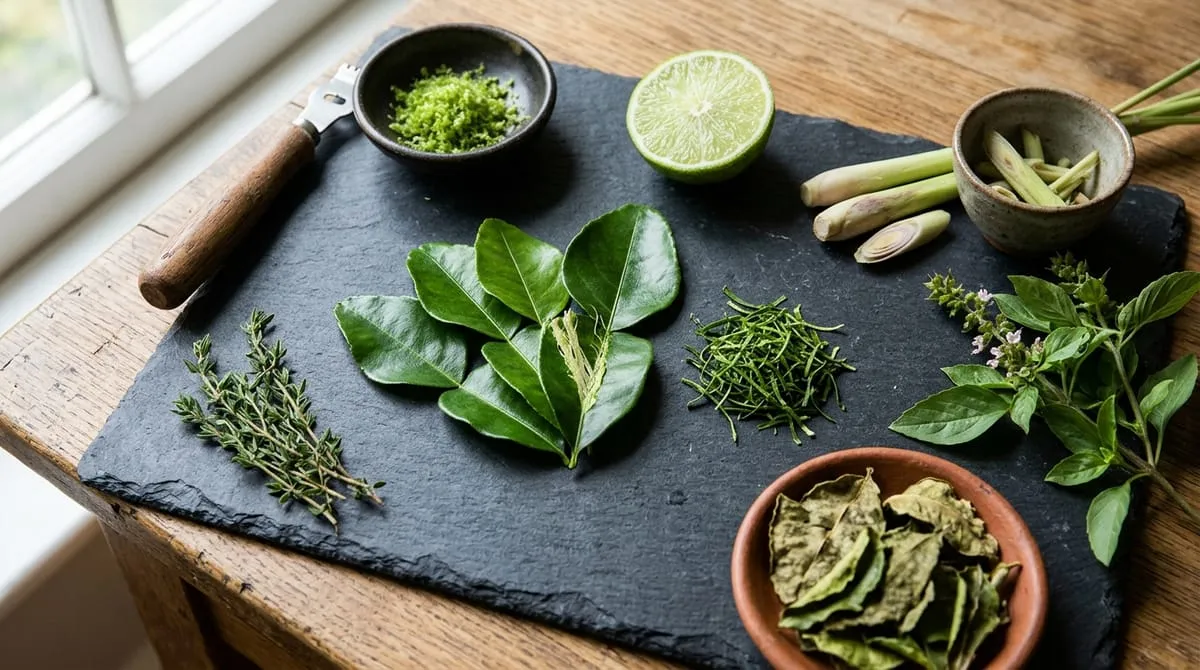
At a Glance: Where to Buy or Substitute
Netherlands Pantry GuideAvailability in the Netherlands
Fresh leaves in plastic clamshells at larger Albert Heijn and Jumbo stores; generous fresh or freezer bags at every Asian supermarket (Amazing Oriental, Wah Nam Hong); dried leaves in the supermarket Asian aisle.
Best Direct Substitute
½ tsp finely grated green lime zest + ½ bruised lemongrass stalk or ½ bay leaf per 2 lime leaves
You are halfway through prepping a pot of Authentic Indonesian Beef Rendang, a fragrant bowl of tom kha kai, or a Thai curry when you hit a crucial aromatic on the ingredient list: 4 makrut (kaffir) lime leaves — sold across the Netherlands under their Indonesian name, djeroek poeroet. Your local supermarket produce shelf is out of fresh packs, the nearest Asian grocery (toko) is closed, and all you have on the counter is a regular green lime and a jar of bay leaves. Do you squeeze in lime juice or reach for the grater?
Put the juicer down. Just like lemongrass (sereh), the biggest misconception about makrut lime leaves is that they make a dish sour. In reality, the leaf adds zero acidity to your pot; its role is purely aromatic, releasing an intensely floral, perfumed citrus-and-pine oil into coconut milk and broth. If you squeeze regular lime juice into a slow-braised curry like rendang or Thai Massaman Curry as a substitute, you shift the pH of the sauce, risk curdling the coconut milk, and still miss the floral perfume entirely.
In this guide, we break down the chemistry behind makrut lime leaves, the two essential preparation methods taught by Southeast Asian cooks (bruising whole leaves vs. hair-thin chiffonade), the 5 best supermarket substitutes with exact ratios by dish type, and why a single freezer bag from a Dutch toko keeps your kitchen stocked for a full year.
What Are Makrut / Kaffir Lime Leaves (Djeroek Poeroet) and Why Are They So Fragrant?
Makrut lime leaves (called bai makrut / ใบมะกรูด in Thai and daun jeruk purut — or djeroek poeroet — in Indonesia and the Netherlands) are the glossy, dark-green leaves of Citrus hystrix, a thorny Southeast Asian citrus tree that bears small, bumpy, wrinkled green fruit. While the name kaffir lime leaves still appears on many European spice jars, culinary publications increasingly prefer the Thai name makrut or the Indonesian/Dutch name djeroek poeroet (as the word kaffir is an offensive racial slur in South Africa).
You can spot a real Citrus hystrix leaf immediately by its distinct hourglass or figure-eight shape: it looks like two leaves fused end-to-end. Technically, the top lobe is the true leaf blade, while the bottom lobe is a flattened, winged leaf stalk (petiole).
The reason a single torn leaf can perfume an entire kitchen comes down to the volatile essential oil trapped inside its microscopic oil glands:
- Citronellal (up to 80% of the leaf oil): Whereas the peel of regular Persian limes and lemons is dominated by limonene and citral (bright, sharp citrus notes), the essential oil of Citrus hystrix leaves is up to 80% citronellal, backed by floral linalool and citronellol. That gives djeroek poeroet an unmistakable, heady, rose-and-pine citrus perfume that is far more complex than ordinary lime peel.
- Zero citric acid: Because you are cooking with a leaf rather than citrus pulp, makrut lime leaves contain no citric acid. Together with galangal (laos), lemongrass (sereh), and tamarind, they form the foundational Southeast Asian aromatic quartet that cuts through rich coconut milk and slow-cooked meat.
The Two Prep Techniques: Tearing Whole vs. Hair-Thin Chiffonade
Fresh or frozen makrut lime leaves have a tough, leathery cuticle. If you toss an intact, unbruised leaf straight into a simmering pot, most of its essential oil stays locked inside the cells; if you chop it coarsely with a knife, diners end up chewing on tough, fibrous pieces of stem. As Pailin Chongchitnant (Hot Thai Kitchen) demonstrates, Southeast Asian kitchens use two specific techniques depending on the dish:
Method A: Fold and tear the center rib (for rendang, soups & braises)
When cooking Authentic Indonesian Beef Rendang, soto ayam, tom yum, tom kha, or a brothy coconut curry, you treat makrut lime leaves just like bay leaves:
- Hold the double-lobed leaf in your hand and fold it in half lengthwise along the woody center vein (with the glossy dark-green side facing out).
- Pinch the bottom of the leaf and tear the tough center stem halfway (or all the way) down, or bruise the folded leaf firmly between your fingers.
- Tearing across the leaf blade ruptures thousands of microscopic oil glands along the tear line so the citronellal oil infuses directly into the hot coconut fat or broth. Do not eat whole braised leaves — simply push them to the side of your plate at the table alongside the galangal and lemongrass.
Method B: Strip the stem and slice into hair-thin threads (< 1 mm) (for Panang curry, fish cakes & stir-fries)
When making a thick Thai Panang curry, tod mun pla (Thai fish cakes), dry stir-fries (or an aromatic finish for Authentic Nasi Goreng), or salads where the leaf is meant to be eaten:
- Fold the leaf in half lengthwise with the dull underside facing out.
- Grip the stem at the base and pull the woody center rib upward in one smooth motion, stripping it out completely so you are left with two tender leaf halves.
- Stack 4 to 6 leaf halves neatly on top of one another, roll them tightly into a compact green cylinder, and use a razor-sharp chef’s knife to slice crosswise into microscopic threads thinner than 1 millimeter (chiffonade). At this hair-thin width, the leathery texture disappears completely and each bite releases a burst of lime perfume.
The 5 Best Substitutes for Makrut / Kaffir Lime Leaves (Ranked by Culinary Function)
If you don’t have fresh or frozen djeroek poeroet on hand, your substitute needs to replicate volatile citrus peel oil plus a subtle green herbal note — without adding sour juice:
1. Finely grated green lime zest + bruised lemongrass or bay leaf (Best all-round supermarket substitute)
The green outer zest of a regular supermarket lime contains volatile citrus oils without any of the acidic juice. Pairing that fresh lime zest with a small piece of bruised lemongrass (sereh) or half a bay leaf restores the herbal, woody leaf backbone that plain zest lacks on its own.
- Ratio per 2 makrut lime leaves: ½ teaspoon finely grated green lime zest (or 1 wide strip of green lime peel,
4 × 1 cm, removed with a vegetable peeler with zero bitter white pith) + ½ bruised stalk of lemongrass (or ½ bay leaf). - Crucial timing rule: While real makrut lime leaves can simmer in a rendang for 3 hours without losing their aroma, regular lime zest loses its volatile oils quickly over long cooking times and can turn slightly bitter if boiled for hours. In slow braises, add the lemongrass or bay leaf at the start, but stir in the fresh lime zest during the final 10 to 15 minutes of simmering.
2. Yellow lemon zest + a pinch of ground coriander seed (ketoembar)
Only have a yellow lemon in the fridge? Lemon zest is brighter and less floral than lime zest, but ground coriander seed (ketoembar) is naturally rich in linalool — one of the exact floral terpene molecules found in makrut lime leaves!
- Ratio per 2 makrut lime leaves: ½ teaspoon finely grated yellow lemon zest + ¼ teaspoon ground coriander seed. Stir the lemon zest in during the final 10 minutes of cooking.
3. Dried djeroek poeroet / kaffir lime leaves from the supermarket (Use double the amount)
Almost every Albert Heijn and Jumbo stocks small jars or packets of dried lime leaves (gedroogd limoenblad or djeroek poeroet) from brands like Conimex, Go-Tan, or Euroma. Be realistic about their potency: industrial drying drives off 70 to 80% of the volatile citronellal oil, leaving dried leaves much duller and more hay-like than fresh or frozen ones.
- Ratio per 2 fresh leaves: Use 4 to 5 dried leaves, crush them lightly in a small bowl with a splash of boiling water for 5 minutes to rehydrate, and finish the dish with a pinch of fresh lime zest before serving to restore the lost top notes. (Never use dried leaves for raw or stir-fried chiffonade garnishes — they remain papery and sharp.)
4. Ground makrut lime leaf powder (djeroek poeroet poeder)
Indonesian spice brands and Dutch tokos sell finely ground dried lime leaf powder (djeroek poeroet poeder). This works well when pounding a smooth Indonesian bumbu paste, satay marinade, or Thai curry paste where whole leaves would get in the way.
- Ratio per 2 fresh leaves: ½ teaspoon djeroek poeroet powder, fried gently in oil with the spice paste so the remaining fat-soluble aromatics bloom.
5. Thai sweet basil (Horapha) or lemon thyme + lime zest (For quick stir-fries & noodles)
Missing the finely shredded makrut lime leaf garnish on a quick stir-fry or noodle dish like Vegan Pad Thai Without Fish Sauce? Combine ½ tsp freshly grated lime zest with a few finely julienned leaves of Thai basil, fresh cilantro, or lemon thyme.
Quick Reference Matrix: Substituting Makrut Lime Leaves by Dish Type
| Dish Category | Best Substitute (for 2 makrut lime leaves) | When to Add | What to Avoid |
|---|---|---|---|
| Slow Braises & Stews (e.g., Indonesian Beef Rendang, Thai Massaman Curry) | 1 strip green lime peel (4×1 cm) + ½ stalk lemongrass (or ½ bay leaf) | Simmer lemongrass/bay leaf from the start; add lime peel for the final 15 min. | Never squeeze in lime juice, and never boil lime peel with white pith for hours (turns bitter). |
| Coconut Soups & Broths (e.g., Tom Kha Kai, Tom Yum, Soto Ayam) | 1 strip green lime peel + 1 thin slice of galangal or ginger | Steep during the final 5 to 8 minutes, then remove before serving. | Do not dump dried lime leaf powder directly into a clear broth (makes it cloudy and gritty). |
| Thick Dry Curries & Fish Cakes (where shredded leaf is eaten) | ½ tsp microplaned green lime zest + ¼ tsp ground coriander | Fold into the warm curry right at the end of cooking or scatter on top. | Never slice dried leaves into chiffonade ribbons; they stay stiff and sharp in the mouth. |
| Pounded Spice Pastes & Marinades (e.g., satay, green/red curry paste) | ½ tsp fresh lime zest + ½ tsp djeroek poeroet powder | Pound or blend directly with the shallots, garlic, shrimp paste (trassi), and lemongrass. | Never use bottled lime juice from concentrate. |
Where to Buy Makrut Lime Leaves in the Netherlands & The Toko Freezer Hack
If you visit an Asian supermarket even once a year (check our Toko Finder Netherlands), you never have to run out of real makrut lime leaves again:
- The Toko Freezer Hack (95% fresh aroma for 12+ months): At Asian grocers like Amazing Oriental, Wah Nam Hong, or local Indonesian and Surinamese shops, you can buy a generous, inexpensive bag of 40 to 60 fresh or pre-frozen djeroek poeroet leaves. Because the leaves have a low water content and a sturdy waxy cuticle, freezing causes virtually zero aroma loss. Keep the bag flat in a zip-top freezer bag in your freezer and pull out 2 to 4 frozen leaves whenever a recipe calls for them. You can tear them or slice them into chiffonade straight from frozen without thawing.
- Albert Heijn & Jumbo: Larger Dutch supermarkets stock small plastic clamshells of fresh lime leaves (verse limoenblaadjes) in the chilled herb section next to the fresh lemongrass and chili peppers. If your recipe only uses three leaves from the pack, pop the rest of the clamshell into the freezer the same day — left in the fridge, they dry out within a week.
Frequently Asked Questions (FAQ)
1. Can you eat makrut (kaffir) lime leaves, or do you remove them before serving? It depends entirely on how they are prepped. When whole or torn leaves are simmered in a braise (like rendang) or soup, you do not eat them: the leathery leaf and central stem remain tough, so you leave them on the side of your bowl just like a bay leaf. However, if you strip out the woody center rib and slice the fresh leaf into hair-thin threads thinner than 1 millimeter (chiffonade), the ribbons are tender enough to eat right along with the dish.
2. Does 1 double-lobed leaf count as 1 leaf or 2 leaves in a recipe? This is a classic point of confusion between Thai and Indonesian cookbooks. Because a Citrus hystrix leaf is shaped like a figure-eight (two lobes joined end-to-end along one stem), some recipes count one full figure-eight leaf as 1 leaf, while others tear the two lobes apart and count them as 2 leaves. Fortunately, you cannot ruin a dish with an extra half-leaf: on Smaakkade, 1 makrut lime leaf (1 blaadje djeroek poeroet) always refers to 1 complete double-lobed leaf. If your freezer bag contains separated single lobes, simply use 2 single lobes per 1 whole leaf.
3. What is the difference between djeroek poeroet (makrut lime leaf) and Indonesian bay leaf (daun salam)? Never swap one for the other! Djeroek poeroet has a double figure-eight shape, a glossy green surface, and an explosive floral citrus scent. Daun salam (Indonesian bay leaf) is a single oval leaf (usually sold dried and brownish-green in the Netherlands) with a subtle, earthy, woody-resinous aroma. Many Indonesian braises (and traditional spice pastes for Authentic Nasi Goreng) use both leaves side by side, as they play completely different aromatic roles.
Recipes Using Makrut / Kaffir Lime Leaves (Djeroek Poeroet)
Authentic Indonesian Beef Rendang (From Scratch)
Make West Sumatran beef rendang from scratch in a Dutch kitchen: using sukadelappen, a freshly pounded bumbu, full-fat coconut milk, and toasted coconut.
Authentic Thai Massaman Curry with Beef, Potatoes & Peanuts
Make velvety Thai Massaman curry from scratch: tender Dutch sukadelappen beef (or 35-min chicken thighs), waxy potatoes, roasted peanuts, and tamarind balance.
Vegetarian Pad Thai (No Fish Sauce)
The authentic taste of Bangkok, but 100% plant-based. Learn the secret of the irresistible tamarind sauce and perfectly chewy, non-sticky noodles.
Authentic Nasi Goreng (No Packets)
Make fragrant Indonesian nasi goreng without spice packets: using chilled jasmine rice, a freshly pounded bumbu paste, and caramelized ketjap manis in a wok.
Video Guide & Culinary Context
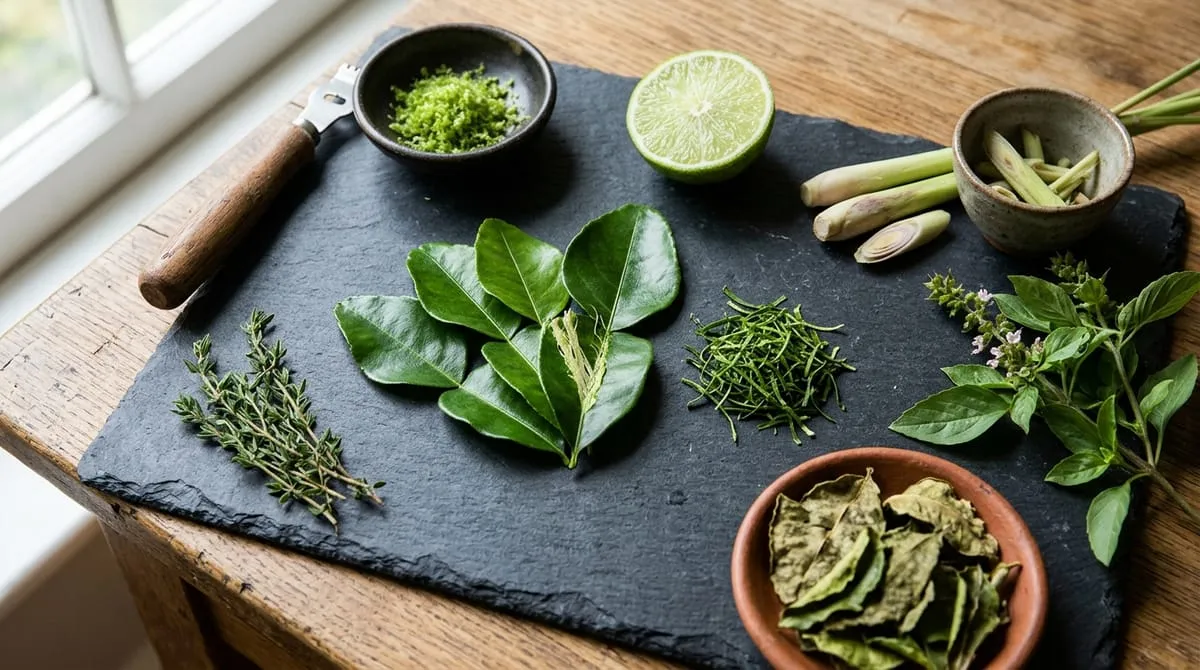
About this video: In this comprehensive ingredient guide (8:00), Pailin Chongchitnant (Hot Thai Kitchen / Pailin's Kitchen) demonstrates how to identify the double-lobed leaf of the makrut lime (known in the Netherlands as djeroek poeroet), why you bruise and tear whole leaves along the center stem for soups and braises, and how to strip out the woody rib to slice hair-thin chiffonade threads for dry curries and stir-fries, along with her freezer storage trick and lime-zest substitution advice.
More Ingredient Guides
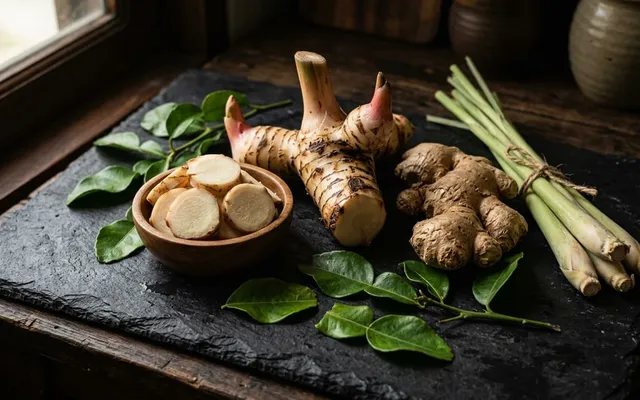
Galangal
Need a galangal substitute or looking for fresh laos vs. laos powder at Albert Heijn, Jumbo, or a Dutch toko? Exact conversion ratios for curry & Tom Kha.
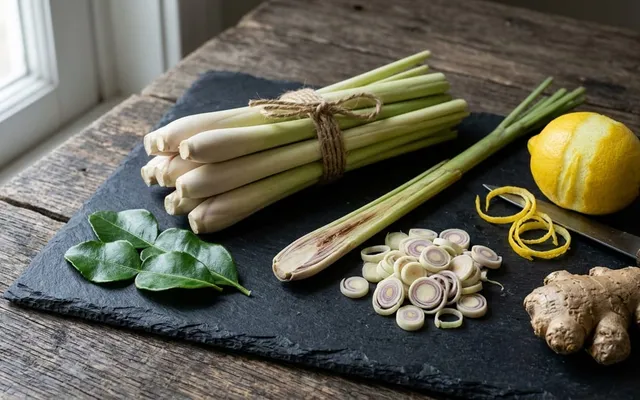
Lemongrass (Sereh)
Out of fresh lemongrass (sereh)? Use our exact substitute ratios for dried lemongrass powder, lime zest + ginger, and paste, plus Dutch buying and freezer tips.
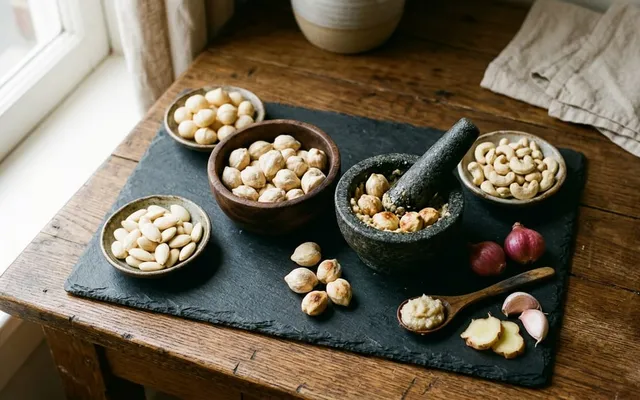
Candlenuts (Kemiri / Buah Keras)
Out of candlenuts (kemiri) for your Indonesian bumbu or rendang? Use our 5 best substitutes (macadamia, cashew, and nut-free) and learn why to toast them.