Anyone with a bag of frozen Bibigo or Ajinomoto gyoza from Amazing Oriental, Albert Heijn, or Jumbo in their freezer has had the exact same thought on a busy weeknight: why dirty a skillet and deal with splattering oil when you can pop them into the air fryer? Yet if you toss frozen gyoza straight into a dry 200 °C air-fryer basket, the result is almost always disappointing. While the filling inside gets piping hot, the thin top pleats dehydrate into pale, rock-hard cardboard shards before the bottoms even brown.
The reason comes down to the dough chemistry of a gyoza wrapper. Unlike puff pastry or egg-roll skins, a gyoza wrapper contains virtually zero fat: it is simply wheat flour, hot water, and a pinch of salt dusted with starch. In traditional Japanese skillet cooking (yaki gyoza), you pour water into the hot pan and clap a lid on top. That steam gelatinizes the wheat starch in the thin top pleats so they turn translucent and tender before the water evaporates and the bottoms fry crisp in sesame oil. Inside the dry, high-velocity airflow of an air fryer, there is no steam phase — so the moisture evaporates out of the thin pleats immediately, leaving raw, chalky dough.
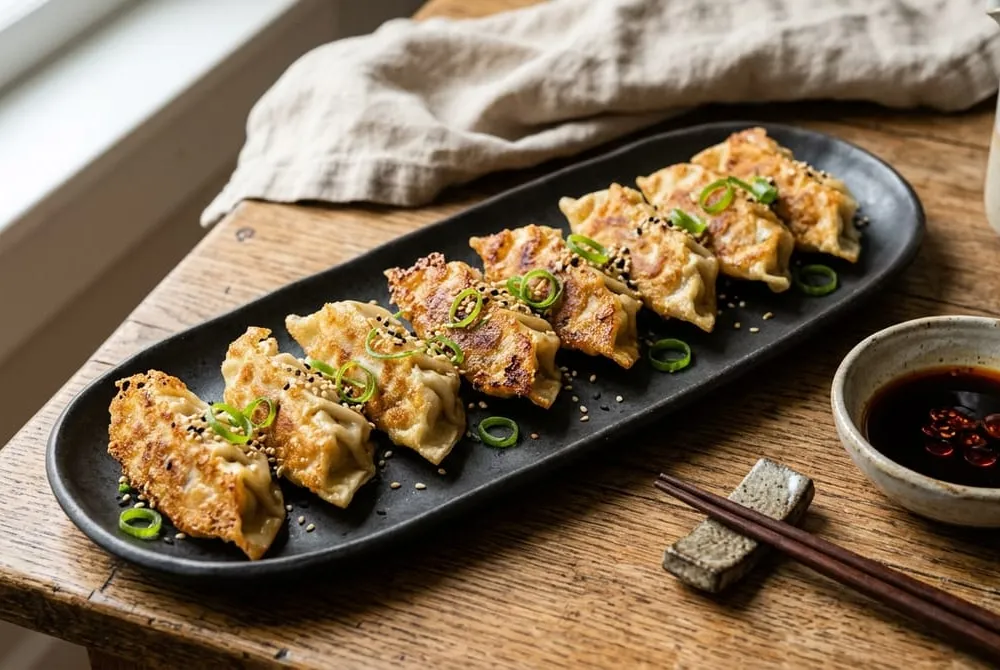
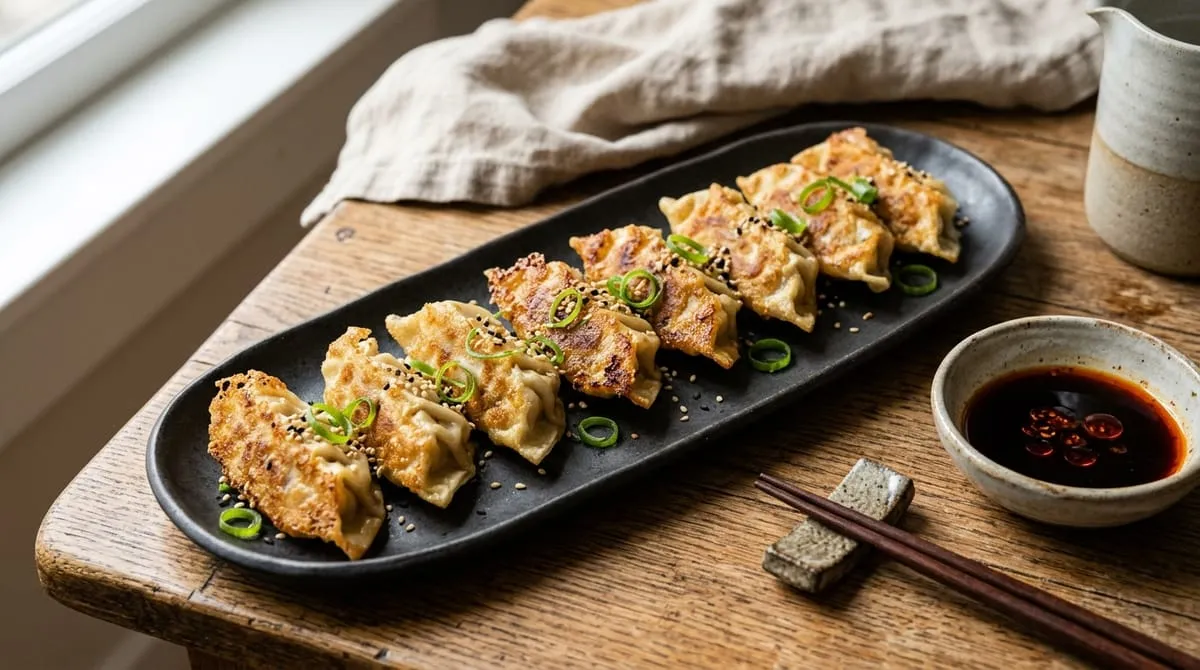
With the Smaakkade Water-Mist & Sesame-Oil Seal Method, you recreate that steam-and-sear effect inside your air fryer in 9 minutes. By tossing the frozen gyoza first with 1 teaspoon of lukewarm water, locking that moisture in under a thin coat of neutral oil and toasted sesame oil, and dropping 1 tablespoon of water into the bottom drawer beneath the basket, the top pleats steam tender during the first 4 minutes while the bottoms blister golden-crisp in the final 5 minutes.
The Science of Air Fryer Gyoza: Why Dry Air-Frying Fails
Understanding what happens to a frozen dumpling between minute 1 and minute 9 explains why this 20-second prep step changes the texture completely:
- Wheat starch gelatinization requires water before oil: Commercial frozen gyoza (Ajinomoto, Bibigo, Vici) are dusted with dry cornstarch or potato starch at the factory so they don’t stick together in the bag. If you spray oil directly onto that dry starch — or air-fry them bare — the top pleats bake into a dry, chalky crust. Tossing the frozen gyoza with 1 teaspoon of lukewarm water for 10 seconds melts surface ice crystals and hydrates the dry starch on the thin pleats so it can gelatinize into a chewy, translucent skin.
- The oil seal locks the hydration inside: Immediately after wetting the wrappers, you toss the gyoza in the same bowl with 1 tablespoon neutral oil + ½ teaspoon toasted sesame oil. That thin lipid film seals the water against the dough so the air fryer’s convection fan cannot strip the moisture away before the wrapper cooks through.
- 1 tablespoon of water in the bottom drawer: Pouring a single tablespoon of water onto the floor of the outer air-fryer drawer (underneath the perforated basket) creates a brief 3-to-4-minute burst of humidity at
190 °C. Once that spoonful of water evaporates around minute 4, the air fryer automatically transitions to dry convection heat, blistering the oiled undersides into a golden crust.
Time & Temperature Table: Frozen vs. Fresh Gyoza & Dumplings
Different dumplings sold in Dutch supermarkets and Asian grocers vary in wrapper thickness and filling weight. Use this chart to nail the exact timing:
| Dumpling Type / Brand in NL | Prep Method | Air Fryer Temp | Exact Cook Time | Texture Result |
|---|---|---|---|---|
| Standard Frozen Gyoza (Ajinomoto, Bibigo, Vici, AH/Jumbo own-label — 20 g each) | Do not thaw! Toss frozen with 1 tsp water + 1 tbsp oil coat + 1 tbsp water in outer drawer. | 190 °C | 8 – 9 minutes (optional: tilt onto sides at min 5) | Blistered golden-crisp base and edges with tender, translucent top pleats and juicy filling. |
| Large Korean Mandu / XL Dumplings (Bibigo King Mandu — 35 g each) | Do not thaw! Same water + oil coat + 1.5 tbsp water in outer drawer. | 180 °C | 10 – 12 minutes | Slightly lower heat so the thicker core reaches > 75 °C before the outer wrapper over-browns. |
| Frozen Mini Wontons (Bibigo Mini Wontons — 9–12 g each) | Do not thaw! Toss with 1 tsp water + 1 tbsp oil (no water needed in outer drawer). | 190 °C | 6 – 7 minutes (shake basket halfway) | All-over crispy wonton crunch — ideal as a quick snack or topping for Quick Miso Ramen. |
| Fresh or Chilled Gyoza (homemade or from the supermarket chilled aisle) | Brush or toss gently with 1 tbsp oil + ½ tsp sesame oil + 1 tbsp water in outer drawer. | 180 °C | 6 – 7 minutes | Note: Never thaw frozen gyoza on a plate first, or the wet bottoms will stick and tear! |
The Golden Ratio Gyoza Dipping Sauce (Gyoza no Tare + Korean Twist)
While the gyoza cook for 9 minutes in the air fryer, it takes 30 seconds to whisk together a proper Japanese tare dipping sauce that beats any plastic sachet:
- Classic Japanese Izakaya Dipping Sauce (Base Recipe): Whisk together 2 tablespoons Japanese soy sauce, 1.5 tablespoons unseasoned rice vinegar, 1 teaspoon mirin, ½ teaspoon toasted sesame oil, and 1 teaspoon crispy chili oil (rayu). The gentle, floral acidity of the rice vinegar cuts straight through the rich sesame-crisp wrapper.
- Spicy Korean Gochujang-Ponzu Dip: Whisk 1 teaspoon gochujang and ½ teaspoon freshly grated ginger into the base sauce above. Perfect when serving Korean mandu alongside Crispy Korean Fried Chicken or Korean Bibimbap.
- Folding your own fresh gyoza? Pick up a pack of round gyoza wrappers from the toko freezer (see our Toko Finder Netherlands) and mix 200 g finely minced Napa cabbage (salted for 10 minutes and squeezed dry) with 150 g minced shiitake mushrooms (or ground pork/chicken), 2 scallions, 1 tsp grated ginger, 1 tsp Shaoxing rice wine, and 1 tbsp oyster sauce. That single teaspoon of Shaoxing wine removes any raw edge and gives the filling true dumpling-house depth.
Step-by-Step Cooking Method
Step 1: Whisk the 30-second dipping sauce (1 minute)
Step 1: In a wide shallow dipping bowl, whisk together 2 tablespoons soy sauce, 1.5 tablespoons rice vinegar, 1 teaspoon mirin, ½ teaspoon toasted sesame oil, and 1 teaspoon gochujang (or crispy chili oil) until smooth. Scatter the thinly sliced scallions and toasted sesame seeds on top and set aside.
Step 2: The 2-step water-and-sesame-oil coat (2 minutes)
Step 2: Preheat the air fryer to 190 °C for 2 minutes. Take 12 to 15 frozen gyoza straight from the freezer (do not thaw!) and place them in a mixing bowl. Drizzle 1 teaspoon of lukewarm water over the frozen dumplings and toss gently with your hands for 10 seconds so every wrapper and pleat is lightly moistened. Immediately pour in 1 tablespoon neutral cooking oil and ½ teaspoon toasted sesame oil, tossing again for 15 seconds until every dumpling glistens evenly.
Step 3: Steam-and-crisp at 190 °C (8 to 9 minutes)
Step 3: Pull out the preheated air-fryer drawer and pour 1 tablespoon of water onto the bottom of the outer pan (beneath the perforated basket). Arrange the oil-coated gyoza flat-side down in a single layer on the basket rack, leaving at least 1 centimeter of space between each dumpling so hot air circulates freely. Air-fry at 190 °C for 8 to 9 minutes. If you want the sides extra blistered as well as the bottoms, use tongs at the 5-minute mark to gently tip the gyoza onto their sides for the final 3 to 4 minutes. Serve immediately while piping hot alongside the dipping bowl — on their own as a snack, or as a crispy side dish next to a steaming bowl of Quick Miso Ramen or Crispy Air Fryer Tofu.
Common Mistakes (And How to Avoid Them)
- Mistake 1: Thawing frozen gyoza on the counter before air-frying. Why it happens: As ice crystals inside the vegetable and meat filling melt, moisture seeps into the bottom of the raw wheat wrapper. When you try to lift a thawed gyoza off a plate, the soggy bottom sticks and rips open. The fix: Always coat and air-fry frozen gyoza straight from the freezer.
- Mistake 2: Only spraying the tops with an oil mister. Why it happens: Setting dry frozen gyoza into the basket and spraying from above leaves the flat bottom and lower pleats dry — and skips the crucial water-hydration step. The fix: Toss them in a bowl for 20 seconds first with 1 tsp lukewarm water and then with 1 tbsp oil so every pleat is hydrated and sealed.
- Mistake 3: Dumping the gyoza in a pile in the basket. Why it happens: Frozen gyoza have delicate pleated edges that snap off if tumbled in a heap, and overlapping dumplings trap wet steam where they touch. The fix: Arrange them upright in a single spaced layer (12 to 15 pieces per batch).
Frequently Asked Questions (FAQ)
1. How long do frozen gyoza take in the air fryer and at what temperature? Standard frozen gyoza (around 20 g each, such as Ajinomoto, Bibigo, or supermarket own-brand) take 8 to 9 minutes at 190 °C straight from frozen. Always toss them first with 1 teaspoon of lukewarm water followed by 1 tablespoon of oil so the top pleats stay tender instead of drying out.
2. How do air-fryer gyoza compare to pan-fried gyoza? In a skillet (yaki gyoza), only the flat bottom develops a crust while the rest of the wrapper steams soft. Using our water-and-oil method in the air fryer gives you a hybrid potsticker texture: a deeply crisp, golden base and edges with chewy, tender pleats on top — without standing over a splattering pan when water hits hot oil.
3. Which frozen gyoza brands in Dutch supermarkets or tokos are best? At Asian supermarkets like Amazing Oriental and in the freezer aisle of larger Albert Heijn and Jumbo stores, two brands stand out: Ajinomoto (classic Japanese izakaya-style gyoza with thin, delicate skins and juicy filling) and Bibigo (Korean mandu-style dumplings with bold garlic, toasted sesame, and glass noodles/tofu inside). Both work seamlessly with this method.
Watch the step-by-step video
External video demonstration supporting the cooking technique. Smaakkade selects relevant culinary demonstrations to complement our source research; follow the written quantities and steps above for this recipe.
Research-led international recipe adapted for kitchens in the Netherlands
Smaakkade is a research-led food publication. For this dish, we cross-referenced trustworthy culinary sources and step-by-step demonstrations, then adapted the method for kitchens in the Netherlands: with metric weights, clear heat cues, and practical guidance on Dutch supermarket substitutes versus specialty toko ingredients.
Bron / Source: https://smaakkade.nl/en/recipes/crispy-air-fryer-gyoza